
Emerging
Published Jun 18, 2026Updated Jun 19 Major3
78%
1,200-Year-Old Major Oak, Legendary Refuge of Robin Hood, Dies After Centuries of Visitor Pressure and Climate Stress
The 1,200-year-old Major Oak in Sherwood Forest, traditionally believed to have sheltered the legendary outlaw Robin Hood, has died after failing to produce leaves this spring. The tree's decline resulted from centuries of soil compression caused by millions of visitors, structural interventions to support its limbs, and climate change-induced heat waves and drought that starved its root system.
Quick Facts
- The Major Oak died after failing to produce leaves in spring 2026
- The tree's root system was found strangled and starved of nutrients
- Soil compression from visitor footfall prevented rainwater from reaching roots
- Structural supports using cables and poles were installed to shore up limbs
- The tree was mentioned in Major Hayman Rooke's book on oaks in 1790
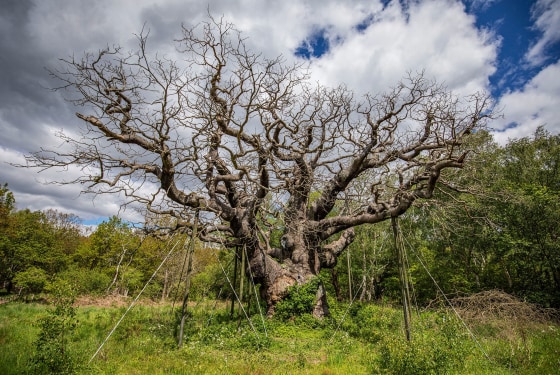
The Major Oak, a 1,200-year-old tree in Sherwood Forest linked to the legend of Robin Hood, has died after failing to produce leaves this spring, the Royal Society for the Protection of Birds announced Thursday. The massive oak, which according to folklore sheltered the legendary 13th-century outlaw who robbed the rich to aid the poor, succumbed to a combination of human and environmental pressures that gradually weakened the ancient tree over decades.
Millions of visitors over the past two centuries compressed soil around the tree's base, preventing rainwater from reaching its root system and causing severe nutrient deprivation. Tree experts found the root system strangled and starved of resources. Additionally, structural interventions to support the tree's massive limbs using cables and poles, while well-intentioned, contributed to its decline. Climate change, bringing prolonged heat waves and drought conditions, further stressed the aging tree. Though fenced off since the 1970s, the cumulative damage from centuries of human visitation and environmental change proved irreversible.
The tree gained widespread recognition in 1790 when Major Hayman Rooke mentioned it in a book about oaks, sparking the first wave of admirers who flocked to Sherwood Forest to view its gnarled limbs and sprawling canopy. Beyond its connection to Robin Hood folklore, Sherwood Forest's oaks hold historical significance—timber from the forest was used to construct ships for Vice Admiral Horatio Nelson's Royal Navy in the late 18th and early 19th centuries, and oak beams support the roof of St. Paul's Cathedral in London.
Hollie Drake of the Royal Society for the Protection of Birds called the tree's death "heartbreaking for everyone," while Ed Pyne of the Woodland Trust drew a stark comparison, describing ancient oaks as "the 'conservation white rhinos of the U.K.' but their decline is far less visible." The organization emphasized that the Major Oak's death highlights the fragility of Britain's ancient trees despite their ecological and cultural importance.
While the tree no longer lives, the RSPB stated that the Major Oak will continue to stand at the heart of Sherwood Forest as a natural monument for visitors. The dead tree and surrounding soil will remain a vital refuge for wildlife, and the knowledge gained from protecting the Major Oak will inform conservation efforts for other ancient oaks across the country. The tree's legacy will persist through its saplings and enduring association with the Robin Hood legend.
Why This Matters
The Major Oak's death illustrates the tension between cultural heritage preservation and visitor access—a challenge facing many historical sites worldwide. Its decline from treading footsteps and climate stress underscores how ancient ecosystems are vulnerable to cumulative human impact, even with protective fencing. The story raises urgent questions about how societies balance tourism, conservation, and climate adaptation for irreplaceable natural monuments.
Timeline & Sources
Jan 1, 1790
WireMajor Hayman Rooke mentions the oak in a book about oaks, sparking wave of visitors
Sources
- Roble Sherwood Bosque Muerto Robin Hood 1b1c421e0199f6c410151f4e0af570e9apWireJun 18, 2026
- Ancient oak tree said to have sheltered legendary Robin Hood has diedNBC NewsMediaJun 18, 2026
- 1,200-year-old Robin Hood oak tree in Sherwood Forest has died, group says: "Heartbreaking for everyone"CBS NewsMediaJun 18, 2026