
Sep 24·Geo
Follow-up 2h ago Major5
100%
Ukraine Airdrops Armed Robots 15km Behind Russian Lines in Operation Vivaldi
Ukraine's Third Army Corps airdropped armed ground robots up to 15 kilometers behind Russian lines during Operation Vivaldi in September 2026, claiming a world-first military tactic. The remotely-operated robots, delivered by heavy drones and equipped with explosives and weapons, reportedly inflicted over 3,000 Russian casualties and enabled the recapture of approximately 48–125 square kilometers in Donetsk while minimizing risk to Ukrainian personnel.
Quick Facts
- Airdropped armed ground robots (UGVs) equipped with explosives and machine guns behind Russian lines
- Remotely-operated robots targeted Russian command posts, supply lines, logistics hubs, and river crossings
- Mine-clearing robots cleared antipersonnel mines from routes
- Over 15,700 robot missions completed during operation
- Recapture of settlements in northern Donetsk region
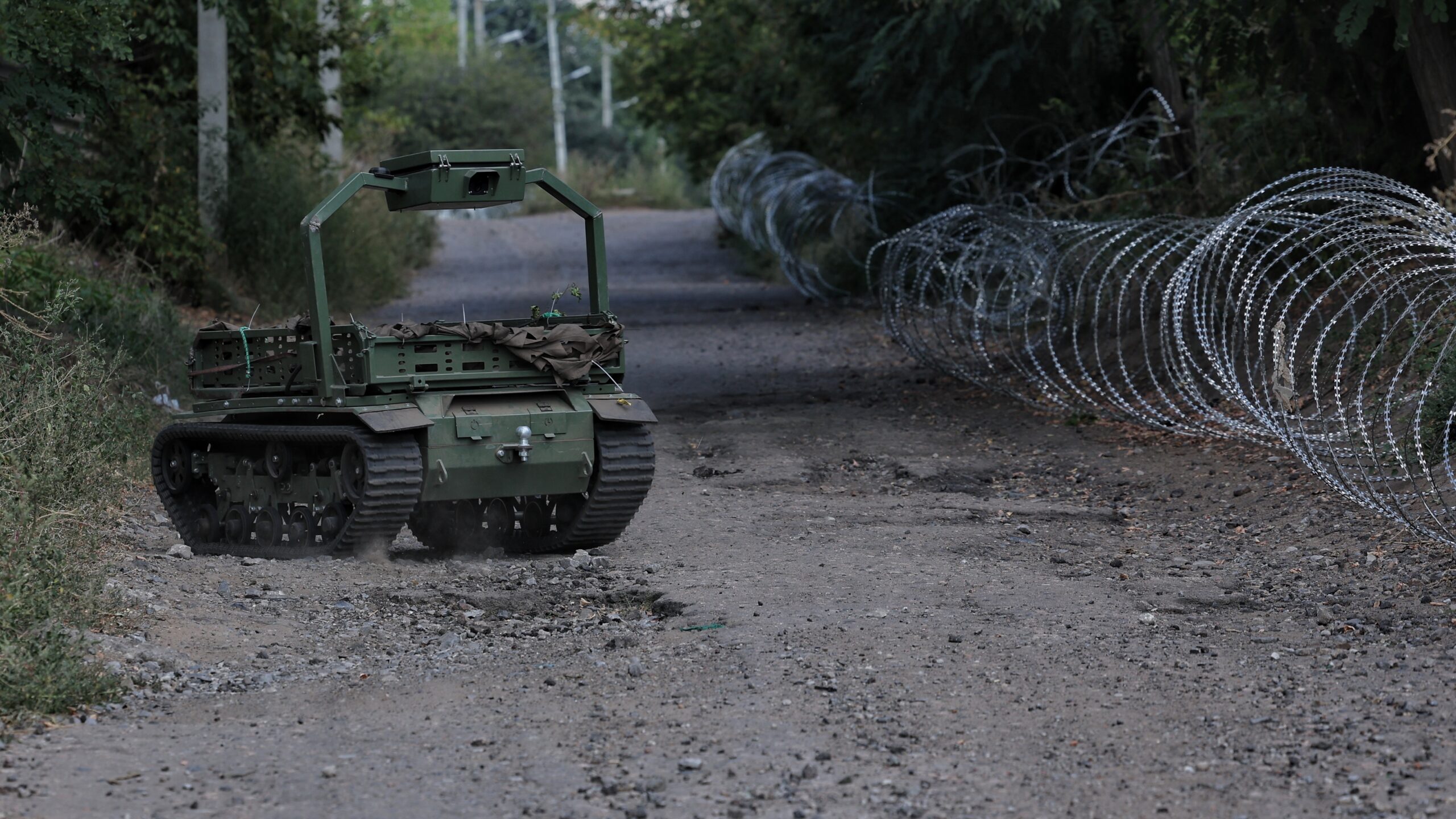


Ukraine's Third Army Corps conducted what it describes as a world-first military operation in September 2026, airdropping armed ground robots deep behind Russian lines during Operation Vivaldi. Heavy bomber drones transported small unmanned ground vehicles (UGVs) equipped with explosives and some fitted with machine guns up to 15 kilometers into Russian-controlled territory in Donetsk. The robots, remotely operated by Ukrainian personnel, independently navigated terrain and engaged Russian command posts, supply lines, logistics hubs, and river crossings without requiring infantry assault.
The operation represented a significant escalation in Ukraine's integration of robotics into combat tactics. Parallel to the armed robot drops, Ukrainian forces deployed mine-clearing robots that safely removed antipersonnel mines from over 18 miles of routes, work that would have required multiple sapper companies and exposed personnel to significant risk. According to Ukrainian sources, robots now handle approximately 60 percent of mine-clearing operations in the Third Army Corps' area of operations.
General Andrii Biletskyi, commander of the Third Army Corps, stated in video released on Telegram that Ukrainian forces had begun "a new stage of the war" with airborne robot deployment. He described the operation as employing a unique deep-strike tactic called "Griffon," named after a missing Ukrainian soldier. Ukrainian officials reported that the operation resulted in over 3,000 Russian casualties (including killed, wounded, and captured personnel) and the recapture of approximately 48–125 square kilometers of territory in northern Donetsk, including the settlements of Shcandryholove, Derylov, and Serednje near Lyman.
The robots completed over 15,700 missions during the operation. Ukrainian commanders noted that surprise and misdirection were critical to success: heavy drone deliveries were preceded by strikes on Russian positions to force personnel into shelters, and electronic warfare measures disrupted Russian reconnaissance, preventing enemy observation of the robot insertions. One intercepted Russian radio conversation showed a Russian officer initially believing his own troops were firing on his position rather than accepting that Ukrainian ground robots had penetrated so far into Russian-held territory.
The operation underscores Ukraine's broader strategy of compensating for manpower constraints by expanding unmanned systems across air, sea, and ground domains. Ukrainian commanders emphasized that robotic systems reduce risk to personnel by assuming high-casualty tasks such as supply runs, casualty evacuation, mine clearance, and direct combat engagements. The reported success of Operation Vivaldi's robot deployment may influence future military doctrine regarding unmanned ground vehicle combat applications.
Why This Matters
Ukraine has deployed armed autonomous ground robots in combat against Russian forces, marking a documented shift in unmanned warfare tactics that may influence military doctrine globally. The operation reportedly yielded territorial gains and inflicted claimed casualties while reducing Ukrainian personnel risk; success or replication of this tactic could reshape how militaries integrate robotics into ground combat, with implications for force composition, training, and supply-chain demands for unmanned systems across NATO and peer militaries.
Sources
- Robots make combat airdrops, clear mines as Ukraine defeats Russian pincerars_technicaMediaSep 24, 2026
- Ukraine airdrops killer robots behind enemy lines to take out 3K Russian troops in ‘historic moment’New York PostMediaSep 26, 2026
- Украина впервые применила боевых роботов против российской армии в ДонбассеРусская служба The Moscow TimesMediaSep 26, 2026
- Украина заменяет пехотинцев дронами: The Telegraph рассказал о новой эффективной тактикеУНИАНMediaSep 27, 2026
- Ukraine-Krieg: Enthüllt! Roboter-Offensive schaltet 3000 Russen ausBILDMediaSep 27, 2026