
Emerging
Published Jun 18, 2026Updated Jun 181
56%
El Niño Confirmed and Strengthening in 2026, Satellite Data Shows
NASA and NOAA have confirmed El Niño's onset in June 2026, with satellite data showing strengthening warm ocean temperatures and elevated sea surface heights across the equatorial Pacific. The event, declared official on June 11, resembles conditions from 1997's exceptionally strong El Niño, though final intensity remains uncertain.
Quick Facts
- El Niño officially declared
- Sea surface temperatures measured above average
- Kelvin waves detected moving eastward
- Sea surface heights elevated in equatorial Pacific
- Trade winds weakened and reversed in western Pacific
NASA and NOAA have confirmed the onset of El Niño in June 2026, marking the return of a natural climate phenomenon characterized by warmer-than-normal ocean temperatures across the equatorial Pacific. NOAA officially declared the event on June 11, 2026, after detecting sea surface temperatures in the central and eastern Pacific that measured at least 0.5 degrees Celsius above average for several consecutive months. Satellite observations from NASA's Sentinel-6 Michael Freilich satellite, launched in 2020 in partnership with the European Space Agency, show elevated sea surface heights across the region—a key indicator that ocean warming is intensifying.
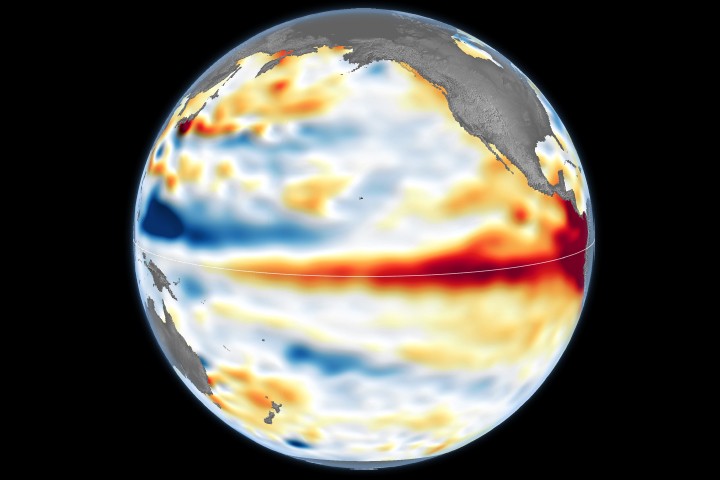
The physical mechanics of the 2026 El Niño began in spring 2026, when trade winds in the western equatorial Pacific weakened and reversed, allowing warm water masses known as Kelvin waves to propagate eastward across the ocean. These waves, some hundreds of miles wide, transport heat from the western Pacific toward the Americas. As warm water accumulated in the eastern Pacific, it deepened the warm surface layer, lowered the thermocline, and suppressed the usual upwelling that keeps coastal waters cooler. Satellite data from June 8, 2026 showed extensive areas of elevated sea levels in the central and eastern Pacific, with red-shaded regions indicating higher-than-average conditions.
JPL sea level researcher Severine Fournier noted that western Pacific conditions on June 8, 2026 resembled those observed in June 1997, the year of an exceptionally strong El Niño event. However, warm conditions had lagged in the eastern Pacific as of that date, with fewer Kelvin waves accumulated than in 1997. Additional Kelvin waves were approaching, suggesting continued strengthening. "For now, it looks like it's going to be a big one," Fournier stated, though he cautioned that further observations would be needed to determine whether 2026 would match 1997's intensity.
El Niño typically brings widespread climate impacts, including wetter conditions to the U.S. Southwest and drought to countries in the western Pacific such as Indonesia and Australia. The phenomenon occurs naturally and recurs at irregular intervals. Understanding sea surface height anomalies provides scientists with crucial insight into subsurface heat storage—a better predictor of climate effects than surface temperature measurements alone, as large reservoirs of heat below the surface have greater impact on global weather and climate patterns than shallow warm layers.
Why This Matters
El Niño can shift rainfall, drought, and storm patterns across multiple continents, so confirming its onset gives governments, businesses, and households time to prepare. Readers in affected regions should monitor seasonal forecasts, water availability, agricultural planning, and disaster readiness, because impacts can differ sharply by location and may intensify as the event strengthens.
Timeline & Sources
Jan 1, 2020
WireSentinel-6 Michael Freilich satellite launched by NASA and ESA
Jun 8, 2026
WireSea surface height anomalies observed across central and eastern Pacific
Jun 11, 2026
WireNOAA officially declares El Niño event after detecting sustained above-average temperatures
Jun 18, 2026
WireNASA publishes analysis confirming El Niño is strengthening