
Emerging
Published Jun 18, 2026Updated Jun 191
56%
Hubble Space Telescope Captures Merging Galaxy Cluster CL0016+1609 and Distant Lensed Galaxies
NASA's Hubble Space Telescope imaged the merging galaxy cluster CL0016+1609, revealing dark matter distribution through gravitational lensing effects and detecting approximately 300 distant high-redshift galaxies lensed by the cluster as part of the RELICS survey.
Quick Facts
- Captured image of merging galaxy cluster CL0016+1609
- Measured dark-matter distribution using gravitational lensing
- Identified high-redshift galaxies lensed by the cluster
- Conducted RELICS (Reionization Lensing Cluster Survey) observations
- NASA

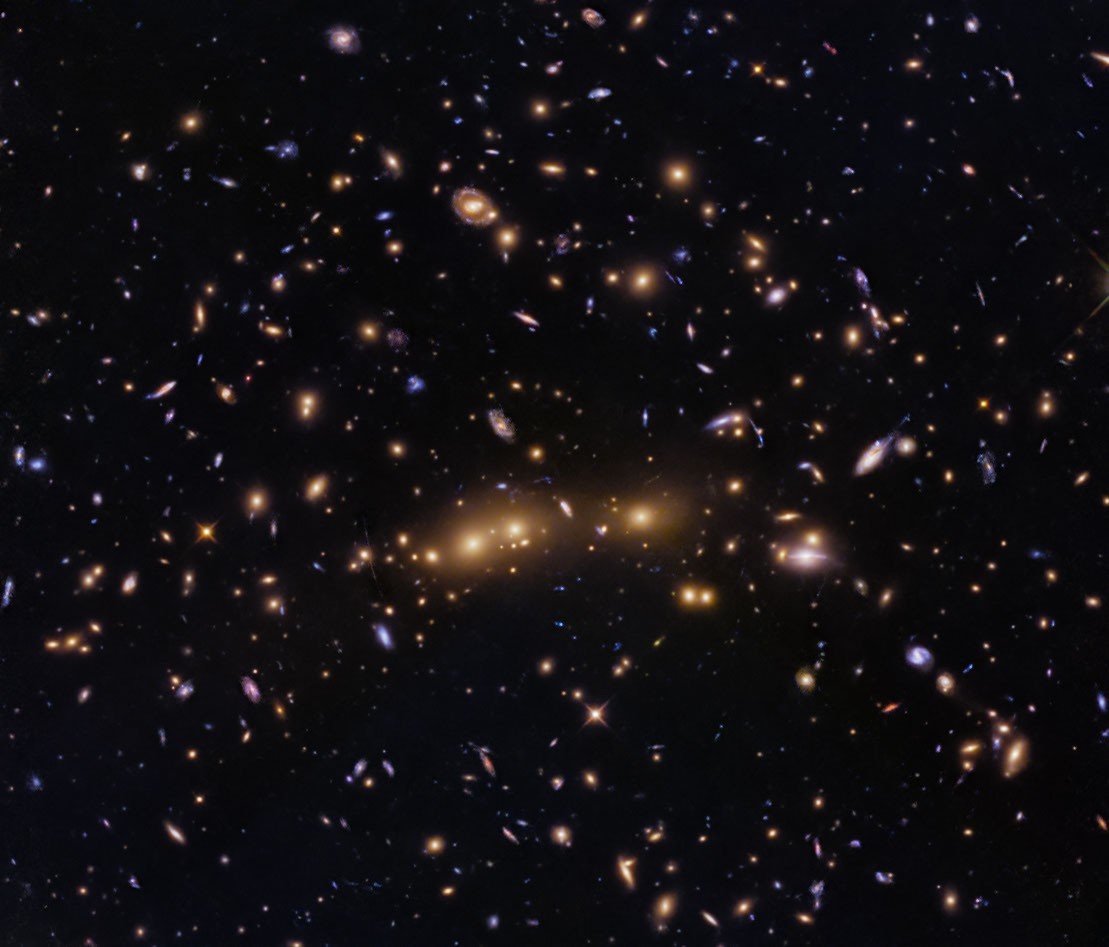
NASA's Hubble Space Telescope has captured a detailed image of the galaxy cluster CL0016+1609, also known as MACS J0018.5+1626, revealing insights into cosmic structure and dark matter distribution. The cluster, one of the most extensively studied objects at X-ray and radio wavelengths, is actually two galaxy clusters merging along our line of sight, as confirmed by X-ray observations. Researchers used Hubble's Advanced Camera for Surveys to measure the cluster's dark-matter distribution, which is invisible to direct observation but detectable through its gravitational lensing effects on visible and infrared light.
The image includes data from Hubble's Wide Field Camera 3 collected as part of the RELICS (Reionization Lensing Cluster Survey), an observing program that obtained the first Hubble infrared images of 46 massive galaxy clusters. The survey identified approximately 300 high-redshift candidate galaxies gravitationally lensed by these clusters. In the CL0016+1609 image, faint arcs reveal distant galaxies whose light has been bent by the cluster's immense gravity—one faint vertical arc appears just to the left of the large elliptical galaxies at the cluster's center, while a brighter but shorter arc is visible just above and to the right of the central elliptical galaxies.
This observation demonstrates Hubble's unique capability to study both dark matter distribution through gravitational lensing and to detect some of the universe's most distant galaxies. The data helps astronomers understand the role of merging clusters in the large-scale structure of the universe and provides valuable insights into cosmic evolution during the universe's early history.
Why This Matters
This observation provides crucial insights into dark matter distribution and the large-scale structure of the universe by leveraging gravitational lensing—a natural cosmic magnifying glass. The detection of ~300 distant high-redshift galaxies helps astronomers understand cosmic evolution during the universe's early history and the role of merging clusters in shaping galactic structures. For readers, this demonstrates how modern telescopes unlock the invisible universe and reveal the mechanisms governing galaxy formation and evolution across cosmic time.
Timeline & Sources
Jun 18, 2026
WireNASA releases Hubble Space Telescope image of merging galaxy cluster CL0016+1609