
Today·Emerging
Follow-up 2h ago Major9
100%
Three Scientists Win 2026 Nobel Prize for Optogenetics Breakthrough
Karl Deisseroth, Peter Hegemann, and Georg Nagel received the 2026 Nobel Prize in Physiology or Medicine for their discoveries in light-gated ion channels and optogenetics. Hegemann and Nagel identified channelrhodopsin in algae; Deisseroth developed it into a technique to control neurons with light, revolutionizing neuroscience research.
Quick Facts
- Awarded 2026 Nobel Prize in Physiology or Medicine
- Discovered channelrhodopsin, a light-sensitive protein in algae
- Developed optogenetics technique to control neurons with light
- Demonstrated light-controlled activation of nerve signals in rat neurons
- Applied technique in living mouse brains
Related Insights
Nobel Prize in Medicine 2026: 3 वैज्ञानिकों को मिला सम्मान, जानिए क्या है Optogenetics तकनीक Jagran Josh · YouTube
Nobel Prize 2026 LIVE: Nobel Prize in Medicine Awarded for Optogenetics Discoveries | IGR India Global Review · YouTube
Nobel Prize in Medicine 2026 | Deisseroth, Hegemann & Nagel Win for Optogenetics PrepPulse · YouTube
Nobel Prize in Physiology or Medicine 2026 — optogenetics #worldnews India Forum · YouTube
2026 Nobel Medicine Prize Honors Scientists Who Learned to Control Brain With Light | AE1G DRM News · YouTube
🏆 2026 Nobel Prize Winner: Light Can Control Your BRAIN?! (Optogenetics Explained in 10 Sec) Easy Science Hub · YouTube
2026 Nobel Prize in Medicine: 3 Scientists Who Changed the Brain | Optogenetics Explained AAROHI FILMS · YouTube
Three Scientists Win 2026 Nobel Medicine Prize For Discoveries In Optogenetics | GBS News | AE1C GBS · YouTube
Neuroscientists win Nobel Prize for breakthrough in understanding how brain creates emotions TheReelyNews · YouTube

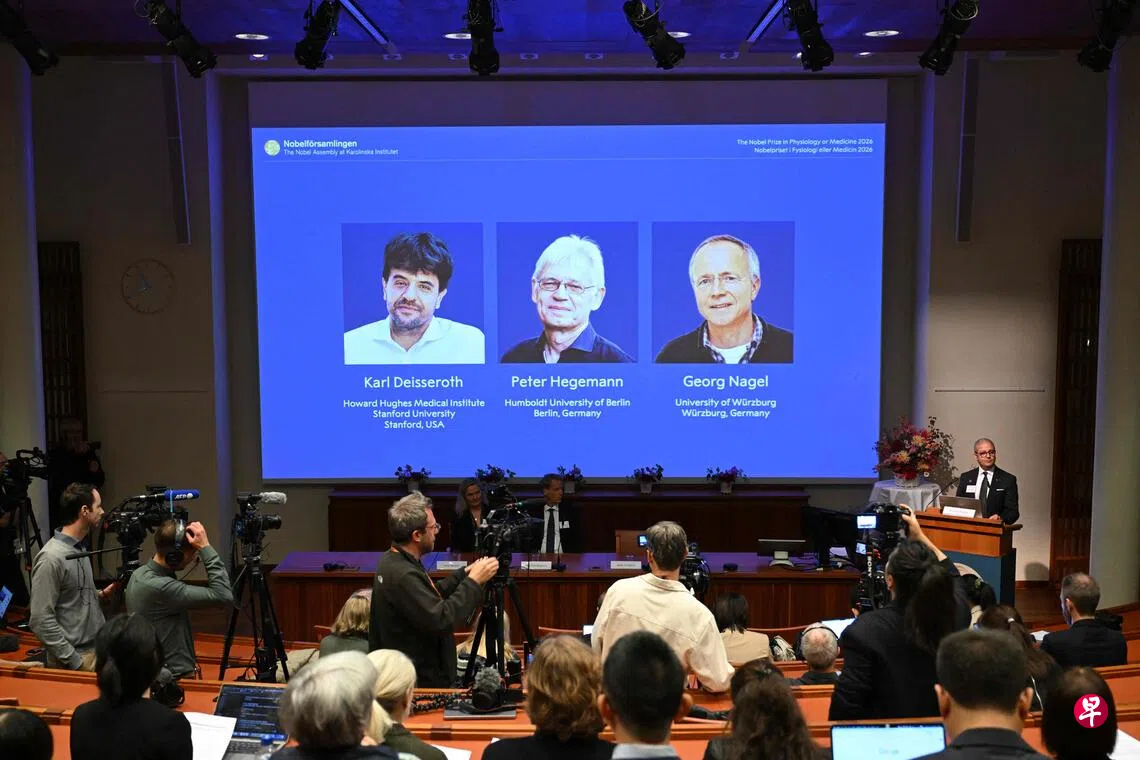

Karl Deisseroth, Peter Hegemann, and Georg Nagel were awarded the 2026 Nobel Prize in Physiology or Medicine on October 5, 2026, for their discoveries in light-gated ion channels and optogenetics. The Nobel Assembly at Karolinska Institutet recognized their work as laying the foundation for a new era in neuroscience.
Hegemann and Nagel discovered channelrhodopsin, a light-sensitive protein found in the single-celled alga Chlamydomonas reinhardtii, in the early 2000s while working at Germany's Max Planck Institute for Biochemistry. When exposed to blue light, this protein opens a channel that allows charged ions to flow into cells, creating electrical impulses. Deisseroth, at Stanford University, adapted this natural mechanism into a practical neuroscience tool by introducing the channelrhodopsin gene into rat neurons, demonstrating in 2005 that blue light could trigger nerve signals with millisecond precision. By 2007, he had successfully applied this technique in the brains of living mice.
Optogenetics enables researchers to precisely control individual neurons and brain circuits using light, allowing them to map causal relationships between specific neural activity and behavior—a capability previously limited to observational correlation. The method has rapidly gained global adoption and is now widely used to study memory formation, emotions, addiction, motor control, and various neurological and psychiatric disorders. Clinical applications include research into restoring vision in people with visual impairment.
Deisseroth holds positions at the Howard Hughes Medical Institute and Stanford University in the United States. Hegemann is a professor at Humboldt University of Berlin, and Nagel is a professor at the University of Würzburg in Germany. The three laureates will share a prize of 12 million Swedish kronor (approximately 1.19 million U.S. dollars).
Why This Matters
Optogenetics enables precise control of individual neurons using light, allowing researchers to establish causal relationships between specific neural activity and behavior with millisecond-scale precision. This capability has been adopted globally to study memory, emotion, addiction, motor control, and neurological/psychiatric disorders, with potential clinical applications for vision restoration in people with visual impairment. The technology has fundamentally changed neuroscience methodology from observational correlation to direct intervention.
Timeline & Sources
Jan 1, 2002
WireHegemann and Nagel identify channelrhodopsin-1
Jan 1, 2003
WireHegemann and Nagel characterize channelrhodopsin-2 (ChR2) as a light-activated cation channel
Oct 5, 2026
WireNobel Assembly at Karolinska Institutet announces 2026 Nobel Prize in Physiology or Medicine jointly awarded to Deisseroth, Hegemann, and Nagel
Oct 5, 2026
WireNobel Assembly announces 2026 Nobel Prize in Physiology or Medicine awarded to Deisseroth, Hegemann, and Nagel
Related Signals
Sources
- Nobel Prize 2026 awarded for showing how nerve cells shape feelingsBBCMediaOct 5, 2026
- Urgent: Trio win Nobel Prize in Physiology or Medicine for discoveries concerning light-gated ion channels, optogeneticsxinhuaMediaOct 5, 2026
- Press release: Nobel Prize in Physiology or Medicine 2026 - NobelPrize.orgNobelPrize.orgMediaOct 5, 2026
- Nobel Prize for Medicine awarded to three scientists for their work in optogeneticstassMediaOct 5, 2026
- 三科学家凭光遗传学研究获诺贝尔医学奖zaobaoMediaOct 5, 2026
- Medicine Nobel awarded for brain ‘switch’ that controls neurons with light: live updatesnatureMediaOct 5, 2026
- 刚刚,诺贝尔奖颁给光遗传学!qbitaiMediaOct 5, 2026
- Trio win Nobel Prize in Physiology or Medicine for discoveries concerning light-gated ion channels, optogeneticsxinhuaMediaOct 5, 2026
- Xinhua News | Trio win Nobel Prize in Physiology or Medicine for discoveries concerning light-gated ion channels, optogeneticsxinhuaMediaOct 5, 2026