
Oct 28·Science
Follow-up 1h ago5
92%
Vera Rubin Observatory discovers largest trans-Neptunian object candidate
Astronomers using the Vera C. Rubin Observatory have discovered 2026 ED138, a potential dwarf planet candidate beyond Pluto's orbit at 46 astronomical units from the Sun. The object, estimated at 600–1,500 kilometers in diameter, is among the largest bodies found in the outer Solar System and awaits infrared confirmation to determine if it meets official dwarf planet criteria.
Quick Facts
- Discovery of potential dwarf planet 2026 ED138
- Analysis of observational data from Rubin Observatory
- Object located beyond Pluto's orbit
- Automated detection using search algorithms
- Confirmation through 30 observations across 20 nights

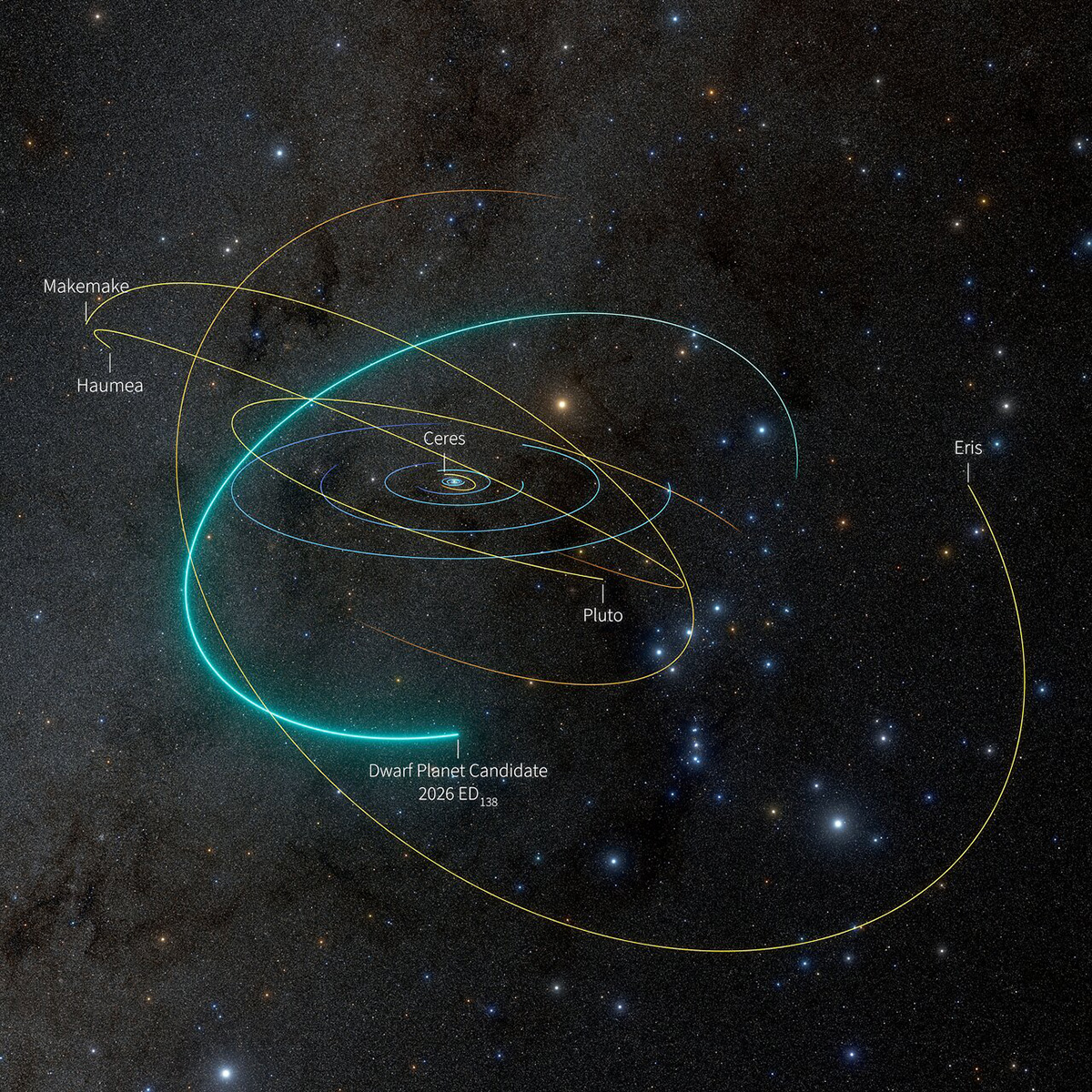
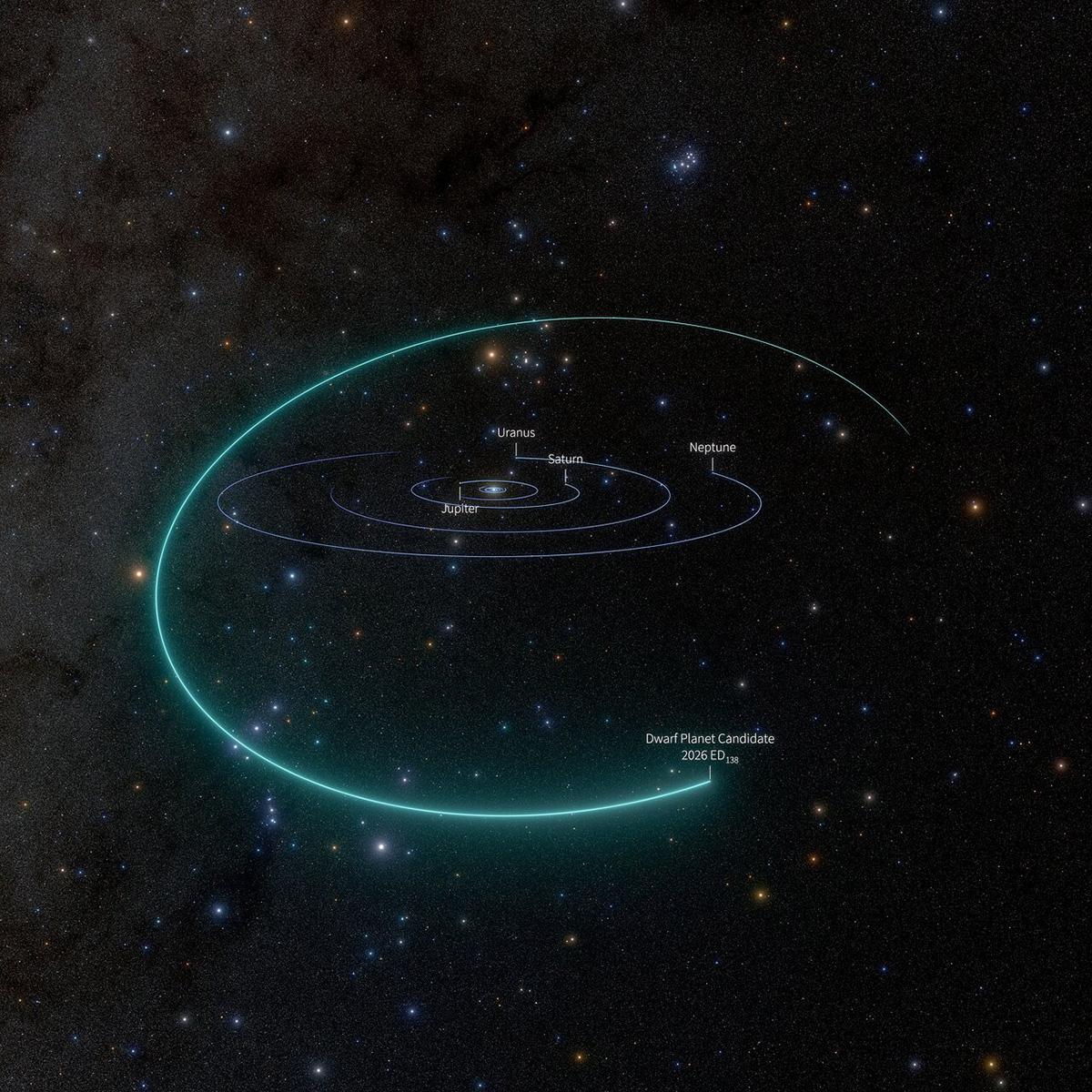
The Vera C. Rubin Observatory has identified a potential dwarf planet designated 2026 ED138, located approximately 46 astronomical units from the Sun—beyond Pluto's orbit of 40 AU. The discovery was made by Matthew Holman of the Harvard-Smithsonian Center for Astrophysics while analyzing observational data collected between March and July 2026 during preparations for the observatory's Legacy Survey of Space and Time. Holman used automated search algorithms to identify moving objects within billions of detections and confirmed the find by locating 30 separate observations across 20 nights, extending the observation history back to 2016 using archival data.
The object is estimated to measure between 600 and 1,500 kilometers in diameter, potentially making it among the largest bodies discovered in the outer Solar System's trans-Neptunian region. Its orbital plane is tilted nearly 25 degrees relative to the ecliptic plane, suggesting gravitational interactions with Neptune displaced it from an original orbit. The object was detected in a crowded region near the Milky Way's galactic plane containing millions of stars, which explains why previous telescopes had not identified it. Rubin Observatory's combination of continuous southern-sky monitoring and advanced detection algorithms enabled the discovery where other instruments failed.
To confirm dwarf planet status, additional infrared observations are required to precisely determine the object's size, shape, and mass. The International Astronomical Union currently recognizes five dwarf planets: Pluto (reclassified from full planet status in 2006), Ceres, Eris, Haumea, and Makemake. If 2026 ED138 meets the criteria—sufficient mass to achieve hydrostatic equilibrium and a rounded shape—it would become the sixth recognized dwarf planet. The discovery demonstrates Rubin Observatory's capability to detect previously unknown distant solar system bodies; the facility has already contributed to locating approximately 2,300 trans-Neptunian objects since beginning operations.
Why This Matters
This discovery expands the inventory of known outer Solar System bodies and demonstrates advanced detection capabilities for distant celestial objects. Confirmation of 2026 ED138 as a dwarf planet would increase the recognized count from five to six and provide astronomers with better understanding of trans-Neptunian region composition and orbital dynamics. The find showcases how modern survey instruments can detect previously unidentified objects in crowded celestial regions, with implications for mapping Solar System architecture and assessing impact risk from distant bodies.
Timeline & Sources
Jan 1, 2016
WireArchival observations of 2026 ED138 recorded (pre-Rubin Observatory discovery window)
Mar 4, 2026
WireVera C. Rubin Observatory begins formal observational data collection of 2026 ED138
Jul 11, 2026
WireFinal observation in initial Rubin Observatory collection period
Oct 13, 2026
WireMatthew Holman discovers 2026 ED138 while analyzing Rubin Observatory data using automated search algorithms
Oct 27, 2026
WireOfficial announcement and NOIRLab visualization release
Sources
- За Плутоном нашли нового кандидата в карликовые планетыНаука MailMediaOct 28, 2026
- За орбитой Плутона обнаружили возможную карликовую планетуtheins.ruMediaOct 29, 2026
- За орбитой Плутона обнаружена, вероятно, новая карликовая планетаOnlínerMediaOct 28, 2026
- 2026 ED138 orbit in 3DNOIRLabMediaOct 29, 2026
- Scientists have found an enormous new dwarf planet beyond Pluto. And there could be many moreBBC Sky at Night MagazineMediaOct 30, 2026