
Today·Emerging
Follow-up 2h ago Major3
95%
Dormant Russian volcano reawakens after 500 years; NASA-India satellite tracks eruption
Mount Krasheninnikov in Russia's Kamchatka Peninsula erupted in 2025 for the first time in roughly 500 years after a magnitude 8.8 earthquake. The NASA-ISRO NISAR satellite has documented the eruption since December 2025 using synthetic aperture radar, creating time-lapse imagery showing lava filling the caldera and overflowing across the landscape.
Quick Facts
- Volcano erupted after approximately 500 years of dormancy
- NISAR satellite monitored eruption with synthetic aperture radar imagery
- Lava filled caldera and overflowed into wider crater
- Time-lapse video compiled from 17 satellite observations
- Primary lava flow directed eastward; secondary flow toward northwest

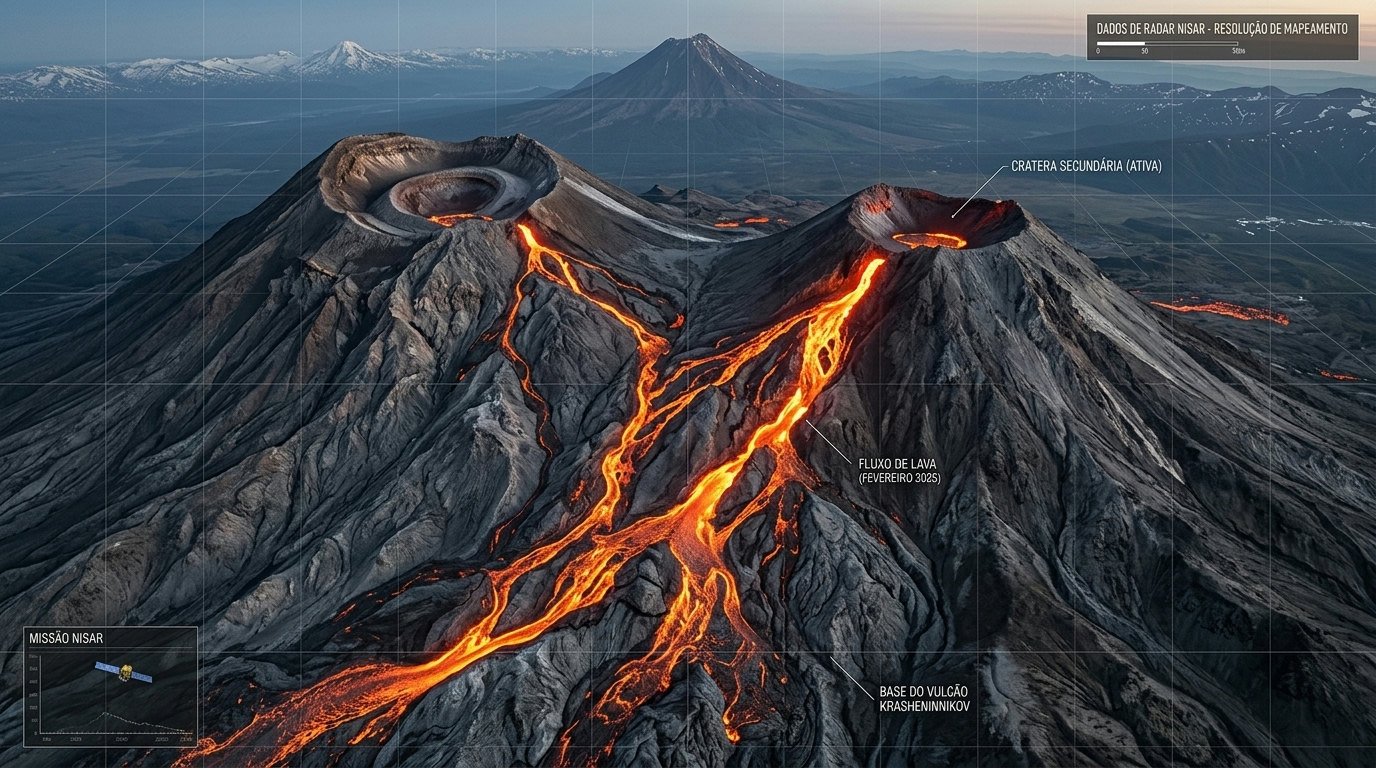

Mount Krasheninnikov in Russia's Kamchatka Peninsula erupted for the first time in approximately 500 years following a magnitude 8.8 earthquake on July 30, 2025. The volcano, which last erupted around 1550, became active shortly after the seismic event, releasing substantial quantities of lava and molten rock that transformed the surrounding landscape.
The NASA-ISRO NISAR satellite has monitored the eruption continuously since December 25, 2025, capturing detailed radar imagery through August 2026. NISAR passes over the volcano every 12 days and uses synthetic aperture radar (SAR) technology to collect high-resolution images regardless of weather conditions or time of day. The satellite transmits thousands of microwave pulses per second to the surface and analyzes returning signals, enabling detection of landscape changes without relying on conventional optical imaging.
NASA compiled 17 satellite observations into a time-lapse video showing lava filling the volcanic caldera and overflowing into a wider crater. The imagery reveals the primary lava flow advancing eastward and a secondary flow toward the northwest, suggesting volcanic activity began before NISAR's first observation. In the microwave radar images, lava appears brighter than surrounding snow and terrain because the surface reflects microwave signals with greater intensity. The pixel resolution is approximately 10 meters by 10 meters.
NISAR is a joint mission between NASA and India's space research organization (ISRO). The satellite is the first space-based platform to carry two SAR instruments operating at different wavelengths—L-band and S-band—and features a 12-meter-diameter drum-shaped reflector antenna, described by NASA as the largest radar reflector antenna ever deployed by the agency. The Krasheninnikov monitoring demonstrates NISAR's practical application for observing volcanic phenomena and other landscape-altering natural hazards at unprecedented frequency and resolution.
Why This Matters
Mount Krasheninnikov's eruption marks a rare geological event—the first activity in ~500 years—providing scientists with real-time data on volcanic processes. NISAR's continuous radar monitoring establishes a precedent for tracking landscape changes in harsh, weather-obscured environments; volcanologists and hazard-assessment agencies now have documented baseline imagery for assessing eruption dynamics, lava flow patterns, and caldera deformation at 10-meter resolution every 12 days. This capability affects volcanic hazard forecasting protocols and early-warning systems for populated regions near active volcanoes globally.
Timeline & Sources
Jan 1, 1550
WireMount Krasheninnikov last erupted, entering approximately 475-year dormancy
Jul 30, 2025
WireMagnitude 8.8 earthquake struck ocean near Kamchatka Peninsula coast
Dec 25, 2025
WireNISAR satellite began monitoring volcanic eruption
Sep 24, 2026
WireNASA released time-lapse video of eruption on social media
Sources
- Terremoto desperta vulcão adormecido há 500 anos na Rússia, e satélite da NASA monitora erupção; veja vídeoCNN BrasilMediaSep 28, 2026
- Gigante adormecido na Rússia: Terremoto de 2025 reativa vulcão e satélite da NASA acompanha erupçãoSobral OnlineMediaSep 28, 2026
- NASA revela vídeo em time-lapse feito por satélite de erupção vulcânica após 500 anos de "sono"O AntagonistaMediaSep 27, 2026