
Sep 16·Geo
Follow-up 2h ago5
92%
Houthis capture Red Sea port and islands, intensify strikes on Saudi oil
Yemen's Houthi rebels have captured the strategic Red Sea port of Mokha and islands in the Bab al-Mandab Strait, launching simultaneous strikes on Saudi oil facilities and military targets. The advance displaces 125,000 Yemenis and threatens global maritime commerce, though shipping traffic has partially recovered. International diplomatic efforts remain nascent, with the U.S. ruling out direct involvement while conducting back-channel talks with Houthi representatives.
Quick Facts
- Houthis captured Mokha port city
- Houthis seized Mayun Island in Bab al-Mandab Strait
- Fighting intensified in Kahbub mountain range, Lahj province
- Houthis launched drone and missile strikes on Yanbu port and Khamis Mushait airbase
- Houthis claimed to have shot down Saudi F-15 fighter jet over Marib
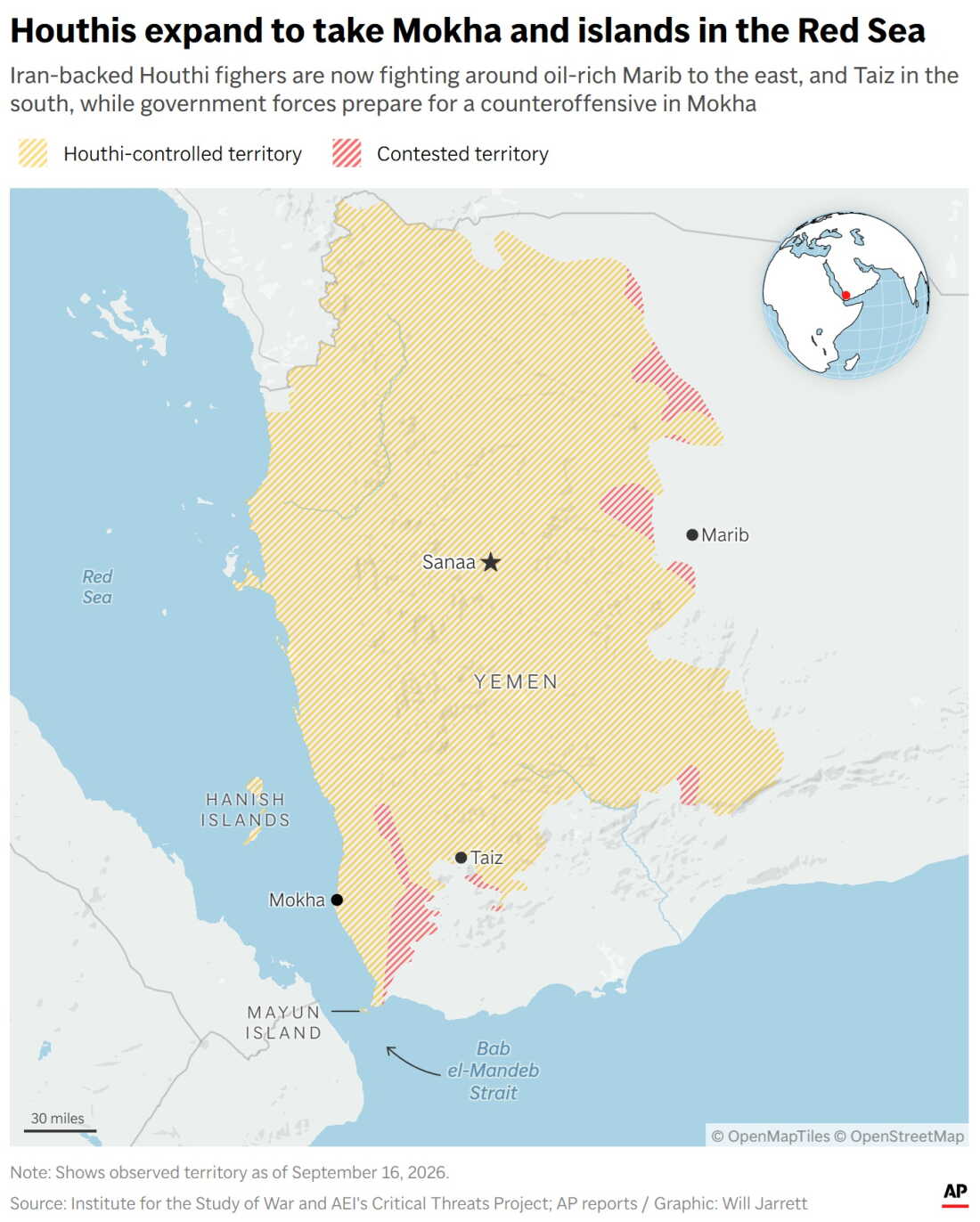




Yemen's Houthi rebels have launched a major offensive down the Red Sea coast, capturing the strategic port city of Mokha on September 10 and seizing Mayun Island in the Bab al-Mandab Strait on September 11. The advance represents the Houthis' largest territorial gain in years and has reignited Yemen's 12-year civil war. Fighting has intensified near the Kahbub mountain range in Lahj province, overlooking approaches to the Bab al-Mandab—a vital maritime chokepoint through which approximately 12% of world trade passes in peacetime.
The Houthis have launched simultaneous strikes on Saudi oil infrastructure and military targets, claiming attacks on the Red Sea port of Yanbu and the Khamis Mushait airbase. They also claim to have shot down a Saudi F-15 fighter jet over Marib province using a locally-made surface-to-air missile. Saudi warplanes have responded with hundreds of airstrikes; Houthi spokesman Yahya Saree reported 40 strikes in 24 hours and claimed as many as 450 strikes this week. The escalation follows pipeline damage blamed on Iran-backed militias in Iraq, compounding energy supply concerns. Brent crude remained above $100 per barrel as of Thursday, though it declined from earlier peaks.
The offensive has displaced approximately 125,000 Yemenis and placed additional pressure on a country already devastated by conflict. The 12-year civil war has killed over 150,000 people and repeatedly pushed Yemen toward famine. The Houthis, who control much of northern Yemen following their 2014 capture of the capital Sanaa, now threaten to advance toward oil-rich eastern provinces. Saudi-backed government forces have launched counterattacks and recaptured heights near the strait, but both sides are reinforcing frontline positions.
International responses remain limited. The United States, which conducted airstrikes against the Houthis under prior administrations, has ruled out direct military involvement. However, American officials held direct talks with Houthi representatives in Oman over the weekend, where the group stated it had no intention of attacking U.S. vessels and remains committed to a 2025 ceasefire with the U.S. President Trump has indicated hope for a diplomatic resolution and plans to meet Gulf leaders at the UN General Assembly. Saudi Arabia has requested missile defence support from France, Pakistan, Egypt, and the United Kingdom, citing depleted interceptor stocks.
Shipping traffic through the Bab al-Mandab declined initially—from 35 daily transits before the Houthi advance to 25 after—but recovered to 45 transits by Sunday. The Houthis have stated their focus is on Saudi-linked shipping and cite Saudi Arabia's long-standing blockade of Houthi-controlled territory as justification for their actions. The offensive reflects escalating regional tensions tied to broader Iran-related conflicts, with the Houthis described by U.S. officials and Gulf states as Iran-backed.
Why This Matters
The Houthi advance controls a strategic chokepoint through which approximately 12% of world trade transits in peacetime. Shipping traffic initially declined from 35 to 25 daily transits but recovered to 45 by Sunday; energy prices remain elevated, with Brent crude above $100/barrel. The offensive has displaced 125,000 Yemenis and escalated military strikes on Saudi infrastructure. Diplomatic channels remain open—the U.S. ruled out direct involvement but held talks with Houthi representatives in Oman; Saudi Arabia requested air-defense support from multiple nations. The confrontation reflects broader regional tensions and competing claims over maritime security, energy supplies, and blockade policies.
Timeline & Sources
Jan 1, 2014
WireHouthis captured Sanaa and much of northern Yemen, triggering Yemen's civil war
Jan 1, 2022
WireCeasefire reached in Yemen civil war
Sep 17, 2026
WireEscalated Houthi strikes on Saudi targets; Houthis claimed F-15 downing; U.S. tightened travel restrictions for Saudi Arabia
Sep 18, 2026
WireShipping traffic through Bab al-Mandab recovered to 45 daily transits
Sources
- Fighting intensifies near Yemen's strategic Bab al-Mandab Strait: sourcexinhuaMediaSep 16, 2026
- Yemeni forces target Houthis as US rules out direct roleAl JazeeraMediaSep 17, 2026
- Saudi, Houthis trade strikes as fighting deepens near Bab al-MandabcgtnMediaSep 17, 2026
- Iran war spreads to Yemen, as Trump hopes for an end soonnewsnationnow.comMediaSep 17, 2026
- What to know after a week of Houthi attacks that threaten Saudi oilNPRMediaSep 18, 2026