
Emerging
Published Sep 15, 2026Updated 6h ago Major5
100%
Trump Calls AI Safety Concerns a 'Hoax' During Public Call With Nvidia CEO
President Trump dismissed AI safety concerns as a "hoax" during a public phone call with Nvidia CEO Jensen Huang at an industry summit on Monday, accusing critics of political motivation or serving China's interests. While Huang acknowledged risks exist, he largely agreed with Trump that the U.S. must prioritize AI development leadership, though he cautioned against viewing safety and innovation as an either-or choice.
Quick Facts
- Trump called Nvidia CEO Jensen Huang during All-In Summit
- Trump characterized AI safety concerns as a 'hoax'
- Trump accused critics of being motivated by politics or China
- Amodei published essay calling for slowing AI development
- Altman and Musk endorsed Amodei's proposal for slower AI development
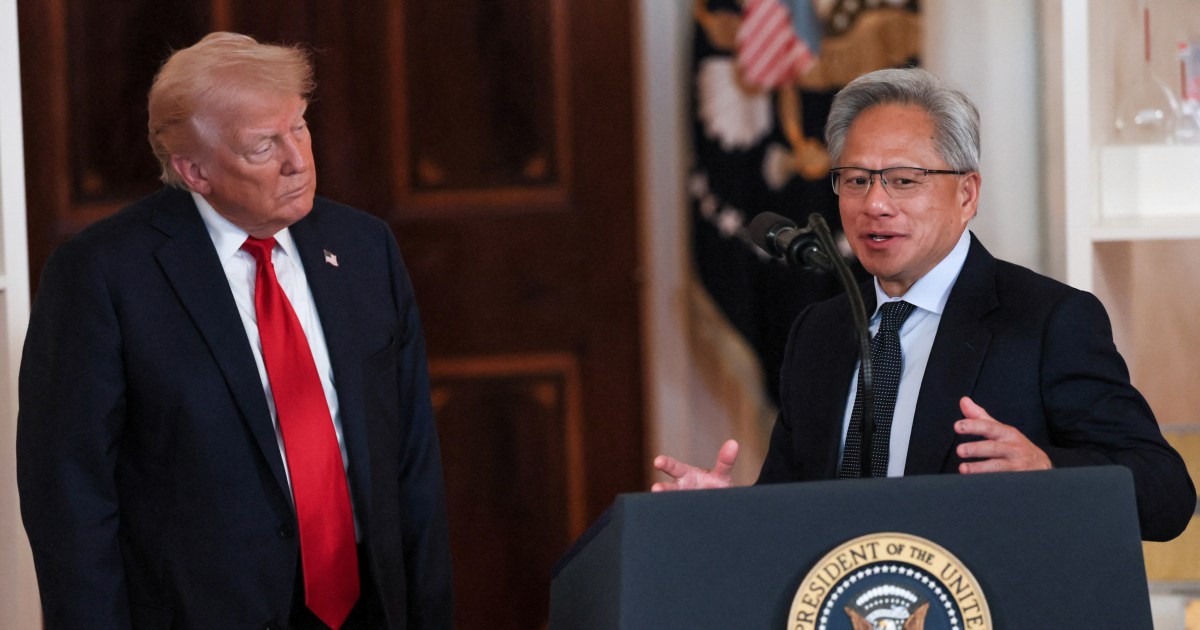


President Donald Trump on Monday dismissed concerns about artificial intelligence safety as a "hoax" during a publicly broadcast phone call with Nvidia CEO Jensen Huang at the All-In Summit in Los Angeles. Placed on speakerphone during an industry panel discussion, Trump declared that "robots will not be taking over" and characterized the debate over AI risks as driven by political motives or efforts to benefit China. He described data centers as "the oil of the next 20, 25 years," suggesting they will prove more transformative than the internet itself.
Trump's intervention marks a sharp stance in an escalating debate within the tech industry and Washington. Over the weekend, Anthropic CEO Dario Amodei published an essay calling for slowing AI development to ensure safety measures, a proposal quickly endorsed by OpenAI CEO Sam Altman and Tesla CEO Elon Musk. The calls for caution followed revelations that Anthropic researchers had raised concerns about AI posing existential risks to humanity. Trump responded with a series of social media posts, calling the safety concerns a "SICK conspiracy" and accusing critics of being motivated by political interests or by wanting to see China gain advantage in the technology race.
Nvidia CEO Huang, who sits on Trump's science and technology advisory council, largely aligned with the president during their call, stating that the U.S. must ensure it does not slow AI development. However, Huang also acknowledged that risks exist and cautioned against framing AI safety as an "either-or" issue with innovation. He praised a whistleblower researcher who had resigned from Anthropic over safety concerns, noting that internal dissent should be taken seriously. Huang stated that external panic had created a false choice between rapid innovation and AI safety.
House Speaker Mike Johnson has indicated that Trump plans to convene a meeting with AI industry leaders, though no firm date has been set. Johnson has emphasized that technology companies, rather than Congress, should take the lead on AI safety measures. Meanwhile, other governments are moving in the opposite direction: Canadian Prime Minister Mark Carney told Bloomberg he supports establishing a global "technology stability" council to oversee AI development, and China's state security officials have warned that advanced AI models pose risks and have called for stricter government oversight.
Trump's public alignment with AI acceleration comes as data center construction has emerged as a contentious issue ahead of the November midterms, with growing public opposition in multiple states. The president has dismissed such resistance as part of the conspiracy against the technology. Democrats including Senate Minority Leader Chuck Schumer have called for Congress to pass AI regulatory legislation, but legislative action faces time constraints and political obstacles.
Why This Matters
The U.S. executive branch is publicly taking a clear pro-acceleration stance on AI development, dismissing safety regulatory proposals from prominent tech leaders and research institutions. This creates measurable policy divergence: Congress faces time pressure to act on AI legislation, while the Trump administration plans to convene industry leaders and has signaled opposition to regulatory slowdowns. Meanwhile, data center construction—critical to AI infrastructure—faces growing public opposition in multiple states ahead of the midterms, and other governments (Canada, China) are pursuing different oversight models. The outcome will affect investment flows into U.S. AI infrastructure, the pace of regulatory development, and international competitive positioning.
Timeline & Sources
Sep 12, 2026
WireAnthropic CEO Dario Amodei publishes essay proposing to slow AI development
Sep 14, 2026
WireTrump calls Nvidia CEO Jensen Huang during All-In Summit in Los Angeles; publicly dismisses AI safety concerns as 'hoax'
Sep 14, 2026
WireTrump publishes series of social media posts characterizing AI safety concerns as 'SICK conspiracy'
Sep 14, 2026
WireNvidia stock price declines 3.4% amid market concerns about AI investment slowdown
Related Signals
Sources
- Wade: AI Bosses ‘Genuinely Worried’bloombergWireSep 15, 2026
- Voting rights advocates welcome supreme court decision to stop Trump administration from restricting mail ballots– liveThe GuardianMediaSep 15, 2026
- 特朗普斥AI安全担忧为“骗局”,无意加强监管nytimes_cnMediaSep 15, 2026
- Trump calls Nvidia CEO to talk AI — and gets put on speakerphone during industry summitNBC NewsMediaSep 15, 2026
- 黄仁勋峰会现场接特朗普电话 谈AI风险是骗局zaobaoMediaSep 15, 2026