
Yesterday·Emerging
Follow-up 2h ago7
92%
First Green Star Discovered 280 Light-Years Away
University of Warwick astronomers have identified WD J1330+6435 as the first white dwarf star that would appear green to the human eye, located 280 light-years away in the constellation Draco. The green color results from the interaction of sodium, calcium, and lithium in the star's ultra-dense atmosphere, revealing that white dwarfs can display a wide range of unexpected colors based on their chemical composition rather than temperature alone.
Quick Facts
- Discovery of first green white dwarf star
- Analysis of stellar colors using spectral data and human color vision models
- Identification of multiple unexpected white dwarf colors: green, pink, cyan, yellow, purple
- Study of 151 white dwarf stars within 65 light-years
- Determination that trace elements in ultra-dense atmospheres produce colors beyond temperature-dependent predictions
Related Insights
The First Green Star Ever Found — 280 Light-Years Away Sidequest Wonder · YouTube
The First GREEN Star Ever Found! CurioBurst TV · YouTube
Scientists Just Found the First GREEN Star 🟢 Astro'nfinity · YouTube
The First Green Star? Scientists Reveal a Stunning Discovery 🟢 #artemis #astronomy #nasa #science Burak Karaca · YouTube
The First Green Star Ever Discovered رازهای فضایی | Space Mysteries · YouTube
What If YOU Saw the First GREEN Star Ever Found? 🟢 #shorts What would happen if ? · YouTube

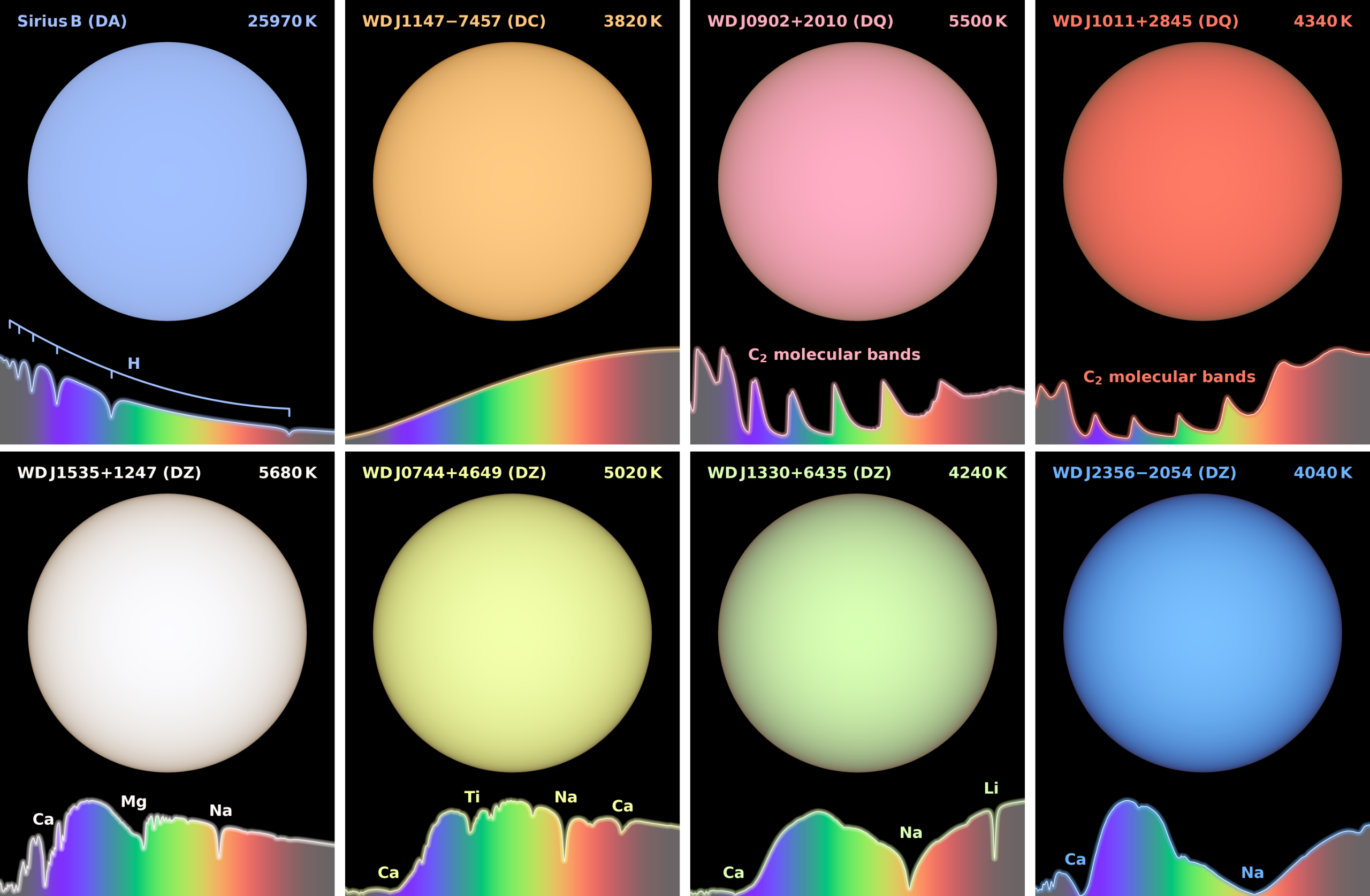


University of Warwick astronomers have discovered the first white dwarf star that would appear green to the human eye, designated WD J1330+6435, located 280 light-years away in the constellation Draco. The discovery challenges the long-held assumption that stellar color is determined solely by temperature, revealing instead that white dwarfs can display an unexpected spectrum of colors including green, pink, cyan, yellow, and purple.
White dwarfs are ultra-dense stellar remnants left behind when sun-like stars exhaust their fuel and collapse. The key to their unusual colors lies in their extreme density—approximately 1 gram per cubic centimetre, roughly the density of water and millions of times denser than the Sun's surface. At this density, trace elements such as sodium, calcium, lithium, and carbon interact with the surrounding helium plasma in ways that cause them to absorb light across a much wider range of wavelengths than they would at lower densities. For normal stars, color depends almost entirely on temperature, limiting them to orange, white, or blue hues.
WD J1330+6435 appears green because its atmosphere has been enriched with rocky material from its planetary system. The sodium in its atmosphere absorbs the orange part of the light spectrum, leaving a chartreuse green glow. Lead researcher Dr. Mark Hollands explained that sodium normally absorbs only a specific wavelength of orange light, but in the white dwarf's ultra-dense conditions, sodium atoms are continuously bombarded by helium atoms, altering their energy levels and causing them to absorb a broader range of wavelengths—yellow, orange, and red—leaving only green light visible.
The research team analyzed 151 white dwarf stars within 65 light-years of Earth, finding that their colors correlate with atmospheric composition. Carbon-rich white dwarfs typically appear pink or purple, while those enriched with debris from shattered asteroids and comets tend toward yellow. Cooler white dwarfs with mixed hydrogen and helium atmospheres often display cyan or pale blue hues. The team also identified WD J1011+2845, which may be the reddest star ever recorded, appearing almost salmon pink due to high concentrations of carbon molecules.
The researchers calculated stellar colors using spectral data—the light fingerprints produced when starlight is separated by wavelength—and ran these data through models of human color vision. This approach reveals not only a star's temperature and chemical composition but also what its light would look like to human eyes. The discovery demonstrates that white dwarfs can serve as diagnostic tools for understanding planetary material and the chemical composition of long-destroyed planetary systems, as the accretion of rocky debris onto white dwarfs preserves evidence of ancient planetary formation.
Why This Matters
This discovery shifts the scientific understanding of stellar color determination, revealing that white dwarf colors are not solely temperature-dependent but shaped by atmospheric chemical composition under extreme density conditions. The finding has measurable implications for astronomical diagnostics: stellar colors now serve as indicators of planetary system history and the composition of accreted rocky debris around dead stars, enabling researchers to reconstruct the chemical makeup of planetary systems destroyed billions of years ago. The analysis of 151 nearby white dwarfs establishes a new observational framework for cataloging stellar diversity and refines models of stellar evolution and planetary accretion.
Timeline & Sources
Oct 15, 2026
WireStudy published in RAS Techniques and Instruments journal; media reports begin
Oct 16, 2026
WireMultiple international outlets report discovery of first green white dwarf star
Oct 17, 2026
WireUniversity of Warwick releases official announcement and detailed research summary
Sources
- Green star discovery makes astronomers the envy of their fieldThe TimesMediaOct 16, 2026
- Green, pink and purple: astronomers reveal the surprising true colors of white dwarf starsEurekAlert!MediaOct 16, 2026
- Astronomers discover the 1st ever green star, a cosmic zombie just in time for HalloweenSpaceMediaOct 15, 2026
- Pela primeira vez, astrônomos identificam estrela verdeFolha de S.PauloMediaOct 16, 2026
- Astrônomos afirmam ter descoberto a primeira estrela verde: as cores que as estrelas normais podem ter são praticamente apenas laranja, branco ou azulCNN BrasilMediaOct 16, 2026
- Astronomers say they’ve discovered the first green starCNNMediaOct 16, 2026
- Green, pink and purple: astronomers reveal the surprising true colours of white dwarf starsUniversity of WarwickMediaOct 17, 2026