
Today·Emerging
Follow-up 6h ago5
92%
India's first domestically built bullet train nears completion for 2027 launch
India's first domestically built bullet train, the B28, is nearing completion at BEML's Bengaluru facility and is scheduled to enter service in 2027 on the Mumbai-Ahmedabad corridor. The eight-coach train will operate at 249 kmph with a 557-passenger capacity, featuring modern amenities, accessibility options for passengers with disabilities, and energy-efficient systems including regenerative braking.
Quick Facts
- Manufacturing of India's first domestically built bullet train (B28)
- Inspection of manufacturing facility and quality testing
- Integration and testing of major components
- Design and assembly of eight-coach train configuration
- Implementation of accessibility features for disabled passengers


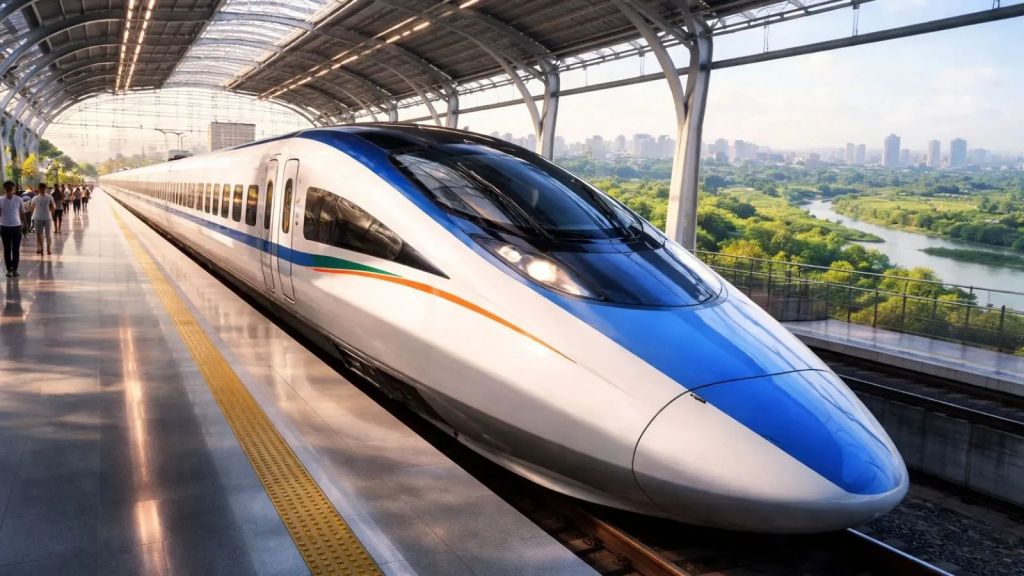

India is advancing toward operational deployment of its first domestically manufactured bullet train, the B28, being assembled at BEML's facility in Bengaluru. Railway Minister Ashwini Vaishnaw inspected the manufacturing process in early November 2026, confirming that major components are being produced, integrated, and tested in accordance with international standards. The train is scheduled to enter service in 2027 on the Mumbai-Ahmedabad High-Speed Rail corridor.
The B28 is designed to operate at a maximum test speed of 280 kmph, with an operational speed of 249 kmph. The eight-coach train measures 202 metres in total length and comprises four motor cars and four trailer cars. It will accommodate 557 passengers across seven standard-class coaches with 3×2 seating and one executive-class coach with 2×2 seating. The design includes provision for coupling two eight-coach trainsets to form a 16-coach configuration for future operational requirements.
The train incorporates modern amenities and accessibility features adapted to Indian passenger needs. Passengers will have access to LED lighting, power outlets for device charging, spacious windows, and LCD displays providing information in English, Hindi, and regional languages. The train includes dedicated seating and toilet facilities for passengers with disabilities, level boarding aligned with platform height, retractable footsteps to minimize gaps, wheelchair-accessible doors, and Braille-enabled signage for visually impaired passengers. The design prioritizes leg space and comfort dimensions suited to passenger body measurements.
Technical specifications reflect focus on energy efficiency and passenger safety. The train operates on a 25 kV, 50 Hz single-phase AC traction system supplied through overhead catenary. It features a regenerative braking system that recovers energy during braking and returns it to the grid. Sound insulation in the car body, noise-damping coatings, and aerodynamic design elements including specialized skirts and bogie covers reduce noise during high-speed operations. Climate control is maintained through modern HVAC systems, with each coach equipped with two units. Emergency communication systems include talk-back units allowing passengers to contact train crew during emergencies. A Wi-Fi-based passenger infotainment system will provide entertainment content during journeys.
The manufacturing process emphasizes quality assurance. Testing procedures include load tests at 1500 kilonewtons to manage atmospheric pressure changes at high speeds—a critical requirement for train safety. Railway officials have stated that every component undergoes testing according to international standards. The project also represents India's advancement toward self-sufficiency in high-speed rail technology, with indigenous engineering and manufacturing capability demonstrated through domestic production at BEML's Aditya Plant rather than foreign procurement.
Topics
Why This Matters
India's completion of domestically manufactured high-speed rail technology affects domestic transportation infrastructure capability, reduces dependence on foreign procurement for rail systems, and establishes measurable manufacturing and quality-assurance processes. The B28 launch on the 508 km Mumbai-Ahmedabad corridor will be the first operational high-speed rail service in India, creating new benchmarks for travel time (approximately 2 hours vs. 6+ hours by conventional rail), passenger capacity utilization, and revenue generation for Indian Railways. Successful operation will demonstrate indigenous engineering capability and may influence future corridor planning and technology adoption timelines.
Timeline & Sources
Nov 2, 2026
WireRailway Minister Ashwini Vaishnaw inspects B28 bullet train manufacturing at BEML facility in Bengaluru, confirming progress and quality adherence to international standards
Jan 1, 2027
WireScheduled launch of B28 service on Mumbai-Ahmedabad High-Speed Rail corridor
Sources
- 'Excellent progress': Ashwini Vaishnaw inspects India's first bullet train manufacturing at BEMLThe Times of IndiaMediaNov 2, 2026
- India’s first bullet train B28: 280 kmph speed, 557 passengers capacity — key features explainedThe Indian ExpressMediaNov 1, 2026
- Bullet Train making: భారత్ తొలి ‘బుల్లెట్ రైలు’ మేకింగ్.. ఫస్ట్లుక్EenaduMediaNov 2, 2026
- గంటకు 280 కి.మీ. వేగం.. 557 మంది ప్రయాణికులు.. విలాసవంతమైన సౌకర్యాలతో భారత బుల్లెట్ రైలుAP7AMMediaNov 2, 2026
- గంటకు 280 కి.మీ వేగం, 8 కోచ్లు, 557 మంది ప్రయాణికులు.. భారత్ తొలి స్వదేశీ బుల్లెట్ రైలు ప్రత్యేకతలివే..!Samayam TeluguMediaNov 2, 2026