Science
Jun 18, 2026 Major2
83%
Seismic Wave Reflected Off Earth's Core May Have Shifted Japan After 2011 Quake
A powerful seismic wave from the 2011 Tōhoku earthquake traveled 2,900 kilometers to Earth's core and reflected back, causing a subtle but widespread eastward shift of Japan by up to 6 millimeters. The movement, detected by GPS stations across the country, occurred about 15 minutes after the main quake and represents a previously unknown type of seismic triggering.



Quick Facts
Who
Sunyoung Park
What
seismic wave reflected off Earth's core
When
March 11, 2011
Where
Japan
- seismic wave reflected off Earth's core
- Japan shifted eastward
- Tōhoku earthquake triggered Fukushima disaster
- GPS and seismic data analysis
- Sunyoung Park
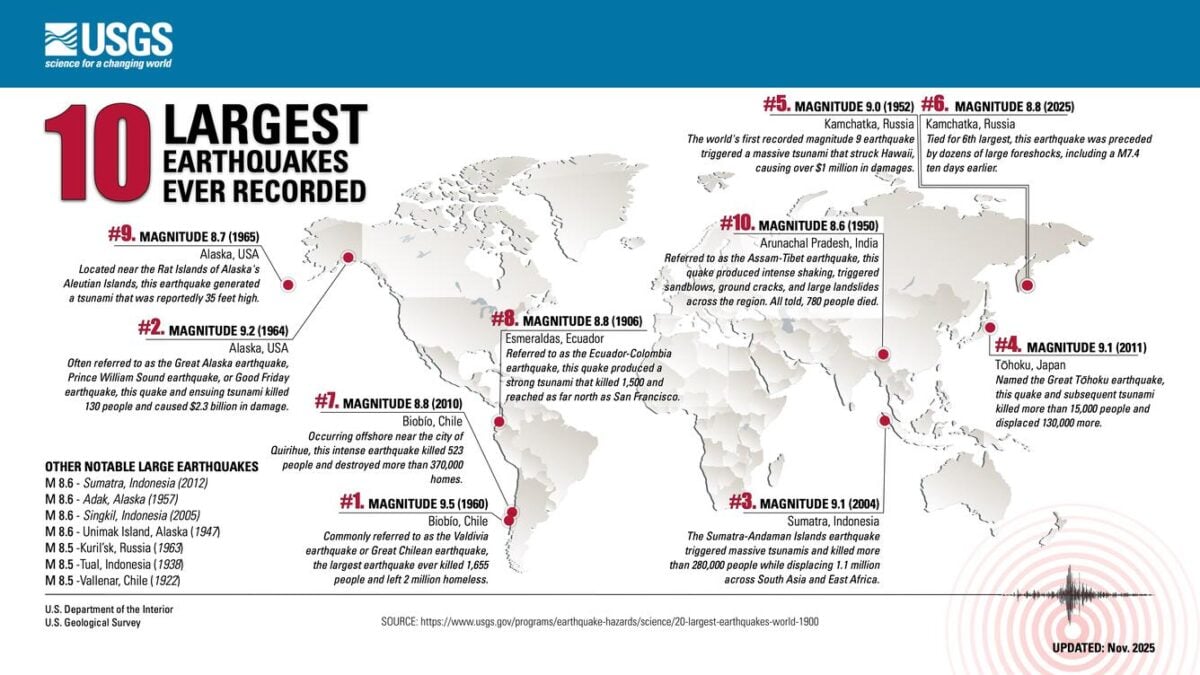
A massive seismic wave from the 2011 Tōhoku earthquake traveled deep into the Earth, reflected off the planet's core, and may have caused a subtle but widespread shift of Japan. Researchers analyzing GPS data found that approximately 15 minutes after the magnitude 9.0 earthquake struck on March 11, 2011, nearly the entire country moved eastward by about 5 to 6 millimeters. The findings, published in Science by a team led by seismologist Sunyoung Park of the University of Chicago, reveal a previously unrecognized phenomenon linked to the powerful earthquake.
The wave, known as an ScS wave (a shear wave that reflects at the core-mantle boundary), traveled 2,900 kilometers (1,800 miles) down to the boundary between Earth's mantle and liquid outer core before bouncing back to the surface. Despite losing strength during its 5,800-kilometer round trip, the wave remained powerful enough to trigger a broad, subtle slip along the fault line. The researchers suggest that the initial earthquake may have already weakened the plate boundaries, making them more susceptible to movement when the reflected wave arrived.
GPS data from Japan's GEONET network showed that the shift occurred almost simultaneously across the entire country, extending over a distance of roughly 3,000 kilometers—nearly seven times longer than the main rupture line of the earthquake. The movement was not a major rupture but a millimeter-to-centimeter scale slip across a vast section of the tectonic plate boundary. Park noted that the shift was observed pretty much everywhere across Japan where GPS stations are located, and likely extended offshore as well.
The Tōhoku earthquake, which generated a devastating tsunami and triggered the Fukushima Daiichi nuclear disaster, remains one of the most closely studied natural disasters in history. This new analysis highlights that large earthquakes can trigger widespread, delayed fault motion minutes later, over much larger regions than previously expected. Robin Lee of the University of Canterbury, New Zealand, emphasized that the finding shows the need for awareness of potential seismic hazards due to deep-traveling waves that can trigger additional events over very large distances. Further research is required to understand the implications for other regions with similar fault systems.
Topics
Why This Matters
This discovery expands our understanding of how large earthquakes can trigger widespread, delayed fault motion over much larger areas than previously expected. For regions near active subduction zones, such as Japan, this means that seismic hazards may persist or even be triggered by deep-traveling waves minutes after the main shock, potentially increasing the risk of aftershocks or additional ground movement across vast distances. Emergency response and early warning systems may need to account for long-period waves that can affect far-reaching fault systems.
Timeline & Sources
Mar 11, 2011
WireMagnitude 9.0 Tōhoku earthquake strikes off the coast of Japan
Mar 11, 2011
WireSeismic wave reflected off Earth's core triggers eastward shift of Japan by 5-6 mm
Jun 18, 2026
WireStudy published in Science revealing the core-reflected wave phenomenon