
Emerging
Published Jun 18, 2026Updated Jun 192
71%
Japanese World Cup Fans Criticized for 'Performance' Trash Cleanup as Gender Roles Row Intensifies
Japanese football fans gained international acclaim for cleaning World Cup stadium stands, but domestic social media backlash accused them of performative virtue-signaling while neglecting household responsibilities. The controversy escalated into a broader debate about gender roles, with data showing Japanese men contribute significantly less to housework than women, and critics questioning whether the cleanup represented genuine civic values or orchestrated image management.
Quick Facts
- Japanese fans voluntarily cleaned stadium trash after World Cup match
- FIFA praised the fans' behavior on social media
- Satirical poster created contrasting public cleanup with domestic inequality
- Online criticism intensified regarding performativity and gender roles
- Data released on household labor disparities


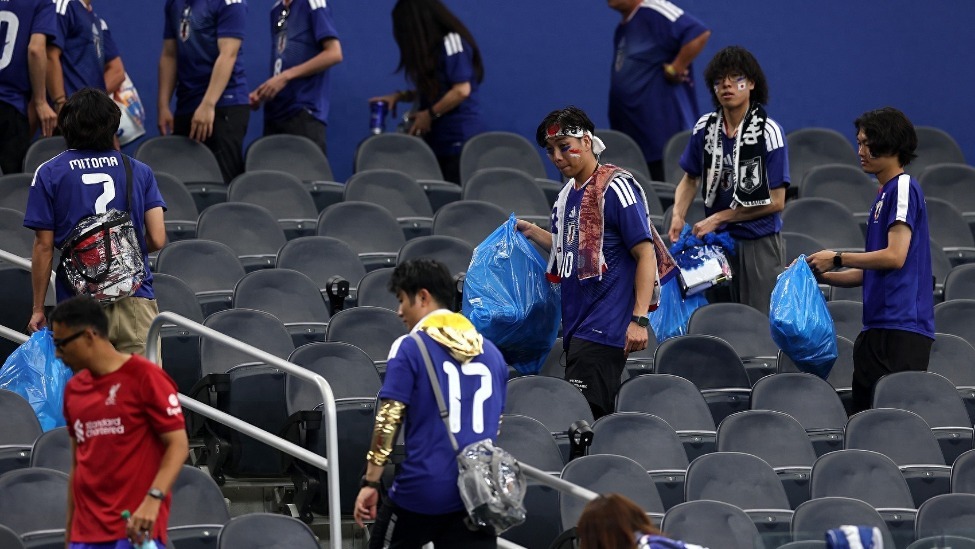


Japanese football fans who voluntarily cleaned stadium stands during the 2026 World Cup earned praise from FIFA as exemplifying high civic standards, but their actions ignited a domestic backlash questioning their sincerity and motives. After Japan's match against the Netherlands in Dallas on June 15, fans were photographed and celebrated on social media for tidying garbage left by spectators. However, a satirical viral poster—shared over 13,000 times on X—challenged this narrative by juxtaposing images of men meticulously collecting rubbish in stadium settings with contrasting domestic scenes depicting the same men lounging on sofas while women performed all household chores alone.
The poster's central critique struck at a disparity supported by data: according to OECD figures, Japanese men rank near the bottom globally in household labor contributions. Japanese government surveys show men spend an average of only 51 minutes per day on housework, childcare, and shopping, compared to 3 hours 24 minutes for women—even as female workforce participation increases. Critics questioned whether the stadium cleanup represented genuine civic values or performative behavior designed to earn international admiration. Online discourse revealed deeper skepticism: some noted that Japanese streets and parks routinely show scattered litter after large domestic events, and questioned why fans did not prevent garbage creation in the first place rather than cleaning up afterward. Several observers pointed to specific staging details—the uniformity of garbage bags bearing logos of APA Hotel (a controversial establishment with ties to historical revisionism)—suggesting orchestrated image rehabilitation rather than spontaneous community action.
The controversy also highlighted competing narratives within Japanese society. Some defenders argued that the cleanup demonstrated genuine environmental respect and that criticisms unfairly conflated public etiquette with domestic arrangements. Others countered that structural inequality—with men working longer hours—partly explained unequal household division of labor. Women activists criticized men for selectively performing virtue in public while evading domestic responsibilities, while some men's rights commentators accused feminists of manufacturing gender conflict and ignoring the positive aspects of the cleanup action itself. Observers from outside Japan noted that large professional sporting venues typically deploy hundreds of dedicated cleaning staff following matches, rendering fan participation supplementary rather than essential to stadium maintenance.
Why This Matters
This controversy reveals tensions between performative public virtue and structural domestic inequality in modern Japan. For global audiences, it illustrates how viral social moments can expose deeper gender disparities that persist despite economic development. For Japanese society, it forces a reckoning with competing narratives: whether to celebrate civic responsibility or interrogate the selective performance of virtue. The debate has immediate policy implications, as Japan's low male housework contribution directly impacts workforce participation, childcare availability, and long-term demographic challenges.
Timeline & Sources
Jan 1, 2021
WireJapanese government survey data reveals men average 51 minutes daily housework vs women's 3 hours 24 minutes
Jun 15, 2026
WireJapan vs Netherlands World Cup match at Dallas stadium; Japanese fans voluntarily clean stadium stands afterward
Jun 18, 2026
WireSatirical poster criticizing the cleanup as performative and highlighting gender inequality goes viral with 13,000+ shares
Jun 18, 2026
WireMajor media outlets (Ifeng, Huxiu) publish detailed critiques of the cleanup narrative