
Today·Emerging
Follow-up 2h ago7
93%
New Wild Cat Species Discovered in Bolivia's Yungas Forests
Scientists have identified Leopardus tilcayo, a new wild cat species from Bolivia's Yungas cloud forest, the first feline species formally described in over 100 years. The discovery, based on genetic analysis of 38 specimens and confirmed through DNA testing of animals at a wildlife sanctuary, also revealed that what was previously considered a single species actually comprises five distinct tiger cat species across South America.
Quick Facts
- New wild cat species Leopardus tilcayo identified and formally described
- Genetic analysis revealed the cat diverged from other Leopardus species ~1.4 million years ago
- Tiger cat genus redefined: single L. tigrinus species split into five distinct species
- New subspecies L. tigrinus antisuyo identified in Peru's Yungas
- Cat arrived at sanctuary after local resident mistook it for domestic kitten
Related Insights
🐆 New wild cat species discovered in Bolivia after 100+ years! 🌿🔬 #Wildlife #Science #newspecies The Green Fix · YouTube
Scientists identify a new wild cat species for the first time in 100 years. Tilcayo tiger ca... OnlyFact · YouTube
A NEW WILD CAT JUST ENTERED THE SCIENCE BOOKS. 🐈 #Wildlife #Science Damn Wisdom · YouTube
A NEW Cat Species Was Just Discovered After 100 Years! 🐆😱 #cate #newcate #trending Razib Channel · YouTube
This Tiny Wild Cat Was Hiding in Bolivia’s Misty Forest! 🐆🌿 #wildcate #trending #newcat Mysterious Tech · YouTube
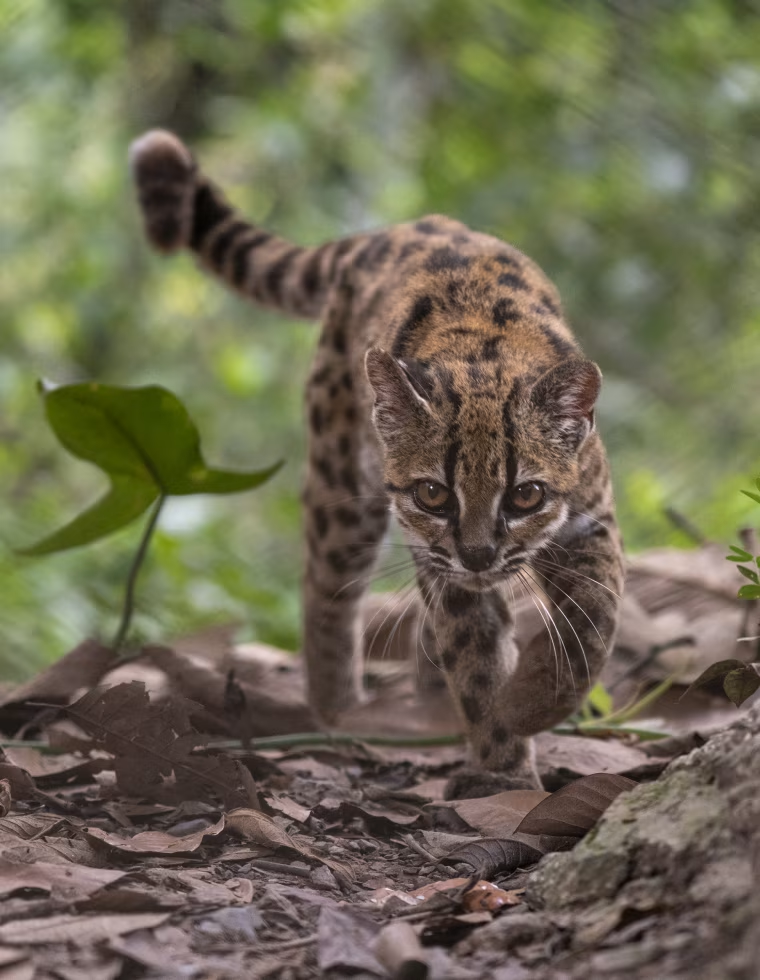


Scientists have identified Leopardus tilcayo, a new species of wild cat from Bolivia's Yungas cloud forest, marking the first feline species formally described to science in over 100 years. The discovery, published in Current Biology, was made through genetic analysis of 38 specimens from Central and South America, including both living animals and museum specimens preserved for decades.
The species was identified after a small spotted cat arrived at the Senda Verde Wildlife Sanctuary in 2016, brought by a local man who initially mistook it for a domestic kitten. Paola Nogales-Ascarrunz, a biologist and National Geographic Explorer leading Bolivia's Felid Research and Conservation Program, recognized the animal's unusual characteristics—notably its larger rosette markings compared to related species—and conducted genetic testing that revealed it as a previously unknown species. The cat diverged from other Leopardus lineages approximately 1.4 million years ago, sufficient genetic distance to establish it as a distinct species.
The Leopardus tilcayo is significantly smaller than a domestic house cat, measuring about 45 centimetres in body length with a 25-centimetre tail and weighing approximately 1.3 kilograms. It has rounded ears, long whiskers, and leopard-like spots. The species name honours the word "tilcayo" used by local Quechua and Aymara communities for generations to describe the animal, representing their ancestral knowledge of the species.
The research also redrew the evolutionary tree of South American tiger cats (genus Leopardus). What was long considered a single species, Leopardus tigrinus, was revealed through genetic analysis to comprise at least five distinct species: L. guttulus, L. emiliae, L. pardinoides, L. tigrinus, and the newly described L. tilcayo. The study identified an additional new subspecies, Leopardus tigrinus antisuyo, in Peru's Yungas region. This reclassification has conservation implications, as species previously grouped under a single "vulnerable" designation may now require individual "threatened" or "endangered" status assessments.
While the only known individual specimen currently lives in captivity at Senda Verde, researchers are installing camera traps in the Yungas forests to document the species in the wild. The habitat faces significant threats from forest clearing, illegal wildlife trade, and diseases transmitted by domestic dogs. The discovery highlights the Yungas region's exceptional biodiversity—an understudied transition zone between the Amazon basin and the Andes mountains characterised by high humidity and dramatic altitude variation, creating isolated microhabitats conducive to species differentiation.
Why This Matters
The discovery of Leopardus tilcayo and the reclassification of the Leopardus tigrinus complex into five distinct species directly affects conservation prioritization: animals previously grouped under a single "vulnerable" designation may now require individual "threatened" or "endangered" assessments, altering resource allocation for protection programs. Camera trap surveys now underway in the Yungas will establish baseline population data; conservation outcomes depend on quantifiable habitat protection measures against documented threats (forest clearing, illegal wildlife trade, domestic dog-borne disease). The reclassification also reshapes scientific understanding of feline evolutionary history and microhabitat speciation in a poorly studied transition zone.
Timeline & Sources
Jan 1, 1775
WireLeopardus tigrinus originally described from specimen observed in French Guiana
Jan 1, 1923
WireLast new feline species formally described by science (pampas cat)
Jan 1, 2019
WireNogales-Ascarrunz notices visual differences between sanctuary cat and reference photos of related species from Brazil
Sep 17, 2026
WireResearch published in Current Biology; Leopardus tilcayo formally described as new species; five tiger cat species formally recognized
Sources
- New wild cat species is identified for first time in 100 years, researchers sayNBC NewsMediaSep 17, 2026
- Meet the First New Cat Species Discovered in 100 YearsNational GeographicMediaSep 17, 2026
- New species of wild cat discovered in Bolivia’s cloud forestBBC Wildlife MagazineMediaSep 17, 2026
- Впервые за 100 лет учёные обнаружили новый вид дикой кошкиЭХОMediaSep 17, 2026
- Природа приберегла сюрприз: в Боливии спустя сто лет обнаружили загадочную дикую кошкуПравда.РуMediaSep 17, 2026
- Nova espécie de felino, primeira descoberta em um século, é achada por brasileiroFolha de S.PauloMediaSep 17, 2026
- Equipe liderada por professor da PUCRS descobre nova espécie de felino selvagem nas florestas da BolíviaCorreio do PovoMediaSep 17, 2026