
Market
Published Aug 5, 2026Updated Aug 6 Major5
100%
South Korean Satellite Documents SpaceX Rocket's Lunar Impact
A SpaceX Falcon 9 upper stage collided with the moon on Wednesday, with South Korea's Danuri satellite capturing before-and-after images showing the impact site near Einstein Crater. The unintended collision was caused by solar activity and gravitational forces; space experts confirm the 4-ton stage struck at 5,400 mph, adding to growing concerns about lunar debris.
Quick Facts
- Falcon 9 upper stage collided with the moon
- Danuri satellite captured before-and-after images of impact site
- Upper stage drifted in orbit for 18+ months before impact
- Chilean telescope detected debris column from impact
- Extremely Large Telescope detected sodium and lithium signatures
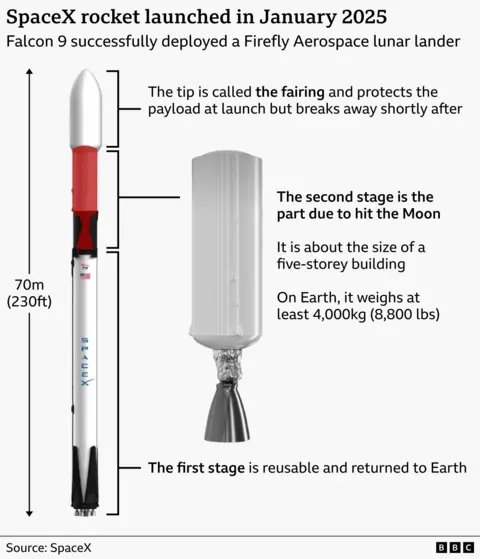
South Korea's Danuri satellite captured the first detailed images of the moon's surface before and after a SpaceX Falcon 9 upper stage collided with the lunar surface on Wednesday, August 6, 2026, at approximately 06:35 GMT. The 4-ton upper stage, traveling at 5,400 mph (8,700 kph), struck the moon near Einstein Crater on the western lunar limb. The Korean Aerospace Research Institute released before-and-after photographs showing a noticeably darker impact site where dust and rock were scattered across the terrain.
The collision was not the result of deliberate action. SpaceX stated that a combination of solar activity and gravitational forces accidentally placed the Falcon 9 upper stage on a collision course with the moon. The rocket had been drifting in orbit since January 15, 2025, when it launched two private lunar landers—Firefly Aerospace's Blue Ghost and ispace's Resilience—from Cape Canaveral. After completing its primary mission, the spent upper stage entered a long, looping orbit that gradually brought it within the moon's gravitational influence.
Space tracking experts and astrophysicists confirmed the impact with high certainty before visual confirmation. Retired astrophysicist Jonathan McDowell stated observations of the dead upper stage on Tuesday night showed it heading directly toward the moon. A Chilean telescope later detected what astronomers identified as debris columns from the impact, with the European Southern Observatory's Extremely Large Telescope detecting sodium and lithium signatures extending tens of kilometers into space for five to ten minutes after impact. Dutch scientist Marco Langbroek and other ground-based observers were unable to observe the impact directly, as the flash would have been too faint to detect from Earth.
NASA's Lunar Reconnaissance Orbiter is expected to fly over the crash site the following week to photograph the impact crater. This incident marks the latest addition to lunar debris, a growing concern as space activities accelerate. In 2022, a Chinese rocket similarly struck the moon unintentionally following a lunar mission. Astronomer Matt Bothwell from the University of Cambridge cautioned that space debris presents an escalating problem, warning that "space is getting more and more crowded" as launch activities increase annually.
The impact occurs as the moon becomes an increasingly busy destination. NASA is planning multiple robotic missions over the coming years to establish a foundation for a sustainable lunar base. SpaceX's Starship is advancing through test flights from Texas, while Blue Origin's Blue Moon lander awaits its first launch. Both companies are developing lunar landers for NASA's Artemis program, with a crewed lunar landing potentially occurring as soon as 2028.
Why This Matters
The unintended lunar impact highlights the growing problem of space debris as lunar activities accelerate. The 4-ton upper stage created a new crater near Einstein Crater, and NASA's Lunar Reconnaissance Orbiter will photograph the site next week. This incident follows a similar unintentional Chinese rocket impact in 2022, and underscores the need for debris management as NASA, SpaceX, and Blue Origin plan more lunar missions, with a crewed landing possible by 2028.
Timeline & Sources
Jan 15, 2025
WireFalcon 9 rocket launches from Cape Canaveral carrying Blue Ghost and Resilience lunar landers
Aug 10, 2026
WireSpaceX Falcon 9 booster scheduled for 18th flight carrying 29 Starlink satellites
Related Signals
Sources
- Spacex Rocket Moon Crash Elon Musk D64a98138fd19241700461c87b49e201apWireAug 5, 2026
- Spacex Cohete Luna Choque Elon Musk 671b4ea010162f03d7b8604467ecbeacapWireAug 5, 2026
- Spacex Luna Choque Cohete Nasa 7b27212bf0a4e332a9e49a354fae03d4apWireAug 6, 2026
- Spacex Rocket Moon Crash 61dc5c43f671623622960013e06aeeb1apWireAug 6, 2026
- South Korea space agency shares Moon images after SpaceX rocket debris crashBBCMediaAug 6, 2026