
Market
Published Aug 4, 2026Updated Aug 6 Major4
100%
SpaceX Rocket Stage Crashes Into Moon Near Einstein Crater
A SpaceX Falcon 9 upper stage crashed into the Moon near the Einstein crater on 5 August 2026 at 8,700 km/h, creating a 20–30 metre crater. After drifting for 18 months, gravitational forces redirected the rocket stage toward the Moon, providing an unexpected opportunity for scientists to observe crater formation and lunar surface composition using ground-based telescopes.
Quick Facts
- Upper stage of Falcon 9 rocket impacted the Moon
- Rocket stage drifted in space for 18 months
- Impact created crater 20–30 metres in diameter
- Plume of debris visible for 5–10 minutes
- Spectral detection of sodium and lithium in impact plume
Related Insights
SpaceX rocket crashes into moon KTLA 5 · YouTube
SpaceX Falcon 9 Rocket CRASHED Into the Moon — What Happened? Ray's Astrophotography · YouTube
LIVE: SpaceX Falcon 9 Crashing Into The MOON! Chuck's Astrophotography · YouTube
SpaceX Rocket Set to CRASH Into the Moon on August 5! Global snap · YouTube
SpaceX Rocket SLAMS into the Moon The National Desk · YouTube
A Falcon 9 Stage Hit the Moon — NASA Explains the Impact ROLL · YouTube
SpaceX Rocket Believed To Have Crashed Into Moon Near Einstein Crater NDTV Profit · YouTube
SpaceX rocket crashes into the moon august 5th 2026 vfx #moon #spacexstarship #astronomy #space ViralVideoLab · YouTube
SpaceX rocket crashes into the moon august 5th 2026 vfx #moon #spacexstarship #astronomy #space ViralVideoLab · YouTube
SpaceX Rocket Set to CRASH Into the Moon at 5,000 MPH! Global snap · YouTube
((REPLAY)) SPACEX MOON IMPACT - LIVE AT4Engineer · YouTube
SpaceX rocket crashes into the moon | The Morning Show Sunrise · YouTube
LIVE: NASA Responds as Suspected SpaceX Falcon 9 Rocket Stage Crashes Into the Moon | APT APT · YouTube
BREAKING: A SpaceX Rocket Just Crashed Into the Moon #space #shorts YouLasy · YouTube
Aug 5 SpaceX Booster Crash into the Moon! Fort Worth Astronomical Society · YouTube
SpaceX rocket crashes into moon!! 😮😲🤯🔍 | #spacex #falcon9 #mooncrash Trend Watch Insider · YouTube
Something Is About To Hit The Moon #spacex #falcon9 #moonimpact Nitesh Upadhyay · YouTube
SpaceX Rocket Boost To Crash Into The Moon On August 5, Create A Crater | Global Lens CNBC-TV18 · YouTube
Why SpaceX Is Crashing Its Falcon 9 Rocket Into The Moon | Explained Mint · YouTube
失控撞擊倒數!3 9噸SpaceX火箭強震月表?#spacex #撞击月球 #moonimpact #falcon9 #Einstein Crater crash 航太解碼 · YouTube
Musk's SpaceX Falcon 9 Rocket Crashes on Moon. Here's Why | Vantage on Firstpost | 4K Firstpost · YouTube
Abandoned SpaceX rocket slams into moon at 5,400 mph, carving new crater 13WHAM ABC News · YouTube
Falcon 9 crashed into moon. Now it contains another scar. #space #nasa #spacex #falcon #moon #crash Parsec Thoughts · YouTube
Our Moon just got HIT by a SpaceX Rocket #moon #space Curious Darpan · YouTube
A Dead Rocket Hits The Moon In 2 Days — And It Has A Terrifying Implication You Aren't Ready To Hear The Space Desk · YouTube
This Rocket ACTUALLY Hit the Moon 😱🚀 #Shorts #Space #Rocket #Moon #MoonImpact #SpaceX #Falcon9 SciFlo · YouTube
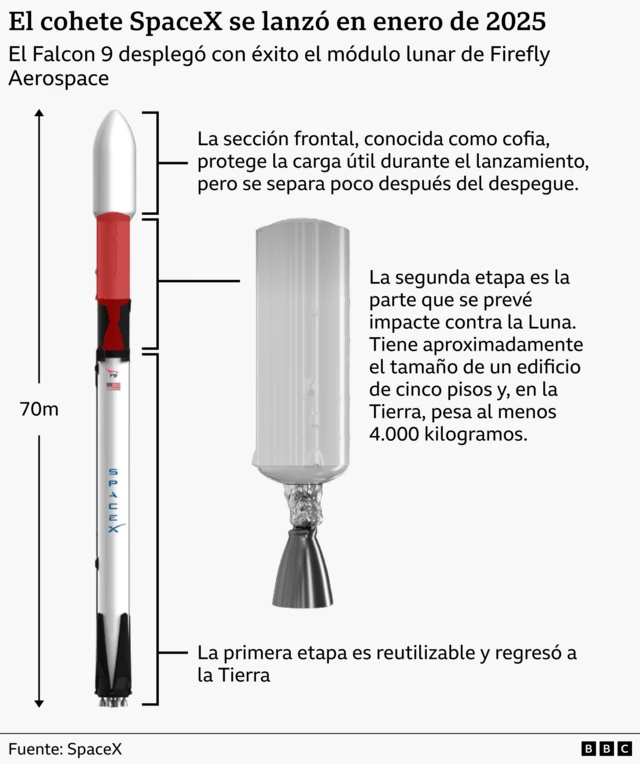


A 14-metre upper stage from a SpaceX Falcon 9 rocket impacted the Moon on 5 August 2026 near the Einstein crater at approximately 8,700 km/h, creating a crater estimated at 20–30 metres in diameter. The collision was unplanned; the rocket stage had been drifting through space for over 18 months after completing its primary mission of deploying two commercial lunar landers in January 2025. Gravitational influences from Earth, the Moon, and the Sun, combined with solar radiation pressure, gradually altered its trajectory into a collision course with the Moon.
The impact occurred at approximately 01:35–02:35 EDT, coinciding with daytime in most of the world, making direct observation difficult. The flash lasted less than a second and was too faint to see with the naked eye or most amateur telescopes. However, a plume of debris and dust ejected from the surface extended several tens of kilometres and remained visible through professional telescopes for approximately 5–10 minutes. The European Southern Observatory at Paranal in Chile and the Very Large Telescope in Chile successfully detected the impact, recording spectral signatures of sodium and lithium gases in the impact plume. Researchers attributed the sodium to lunar regolith and the lithium likely to the rocket itself.
Bill Gray, developer of the Project Pluto astronomical software, first identified the collision risk in April 2026 after monitoring the rocket stage's orbit. NASA's Lunar Reconnaissance Orbiter was positioned to photograph the impact site in subsequent days, enabling comparison of before and after imagery. Scientists emphasised that the impact posed no risk to Earth and represented a rare scientific opportunity to study crater formation and lunar surface dynamics in real-time, supporting future lunar exploration planning.
The Falcon 9 rocket had launched from Florida on 15 January 2025, carrying two lunar landers: Blue Ghost from Firefly Aerospace (which successfully landed) and Resilience from Ispace (which crashed on impact). For lower Earth orbit missions, SpaceX typically allows upper stages to burn up in the atmosphere; however, for high-energy lunar missions, the company performed a de-orbit manoeuvre intended to render the stage safe. Natural gravitational and solar pressures ultimately redirected it toward the Moon. The incident renewed discussion of space debris management in deep space, where discarded stages can drift for years or decades without burning up.
Why This Matters
The unplanned impact of a 14-metre rocket stage on the Moon provides measurable scientific data on crater formation and lunar surface composition. Space debris tracking showed the stage drifted 18 months before collision; this event raises observable questions about long-term debris management in deep space, where discarded stages can remain in uncontrolled trajectories for years without atmospheric burnup. Lunar Reconnaissance Orbiter imagery comparison before/after impact supports empirical lunar science and informs future lander deployment protocols. The spectroscopic detection of sodium and lithium in the impact plume enables real-time compositional analysis of regolith and vehicle materials.
Timeline & Sources
Jan 15, 2025
WireFalcon 9 launched from Florida with Blue Ghost and Resilience lunar landers
Aug 5, 2026
WireUpper stage impacted the Moon at approximately 8,700 km/h near Einstein crater
Related Signals
Sources
- Qué puede aprender la ciencia del choque contra la Luna de un cohete de SpaceX que estaba a la derivaBBCMediaAug 4, 2026
- Parte de foguete Falcon 9, da SpaceX, vai se espatifar na Lua nesta quartaFolha de S.PauloMediaAug 4, 2026
- Un cohete de SpaceX chocó con la Luna. Estas son las clavesCNN en EspañolMediaAug 4, 2026
- Chatarra espacial de SpaceX a la deriva impactará la Luna este miércoles a 9.000 km/hBioBioChileMediaAug 4, 2026