
Today·Emerging
Follow-up 3h ago Major3
96%
NASA confirms largest recent lunar crater formed in 2024
NASA announced the discovery of crater McGetchin, the largest known recent impact crater in the Solar System, formed in April–May 2024 with dimensions of 222 meters diameter and 43 meters depth. The crater was detected by the Lunar Reconnaissance Orbiter and confirmed in 2026; such impacts occur approximately once every 130 years.
Quick Facts
- Impact crater formed on the Moon
- Crater named McGetchin
- Detected via Lunar Reconnaissance Orbiter imagery comparison
- Thermal anomaly documented around crater
- Research published in Science Advances
Related Insights
New Moon Crater Discovered: चांद पर बना विशालकाय गड्ढा, NASA ने खोजा ऐतिहासिक McGetchin क्रेटर! India News Bihar Jharkhand · YouTube
NASA Found a Massive New Moon Crater — Bigger Than the Colosseum CosmicFuse · YouTube
NASA Just Found A Brand-New "Once-In-A-Century" Crater on the Moon! Orbit Proof · YouTube
What If You DIED on Every Planet in the Solar System? Falling Upward · YouTube
A once-a-century impact hit the Moon and nobody noticed for 18 months · voice by elevenlabs.io Non trivial Daily · YouTube
NASA Just Found a Crater That Wasn't There 2 Years Ago 😱 #NASA #Moon #Space #Astronomy Dan Beyond · YouTube
A Giant Asteroid Just Smashed a Hole in the Moon 💥🌕 VidPulse · YouTube
Researched: A 222 Metre Crater Appeared on the Moon. Why Did Nobody Notice? Researching WHY · YouTube
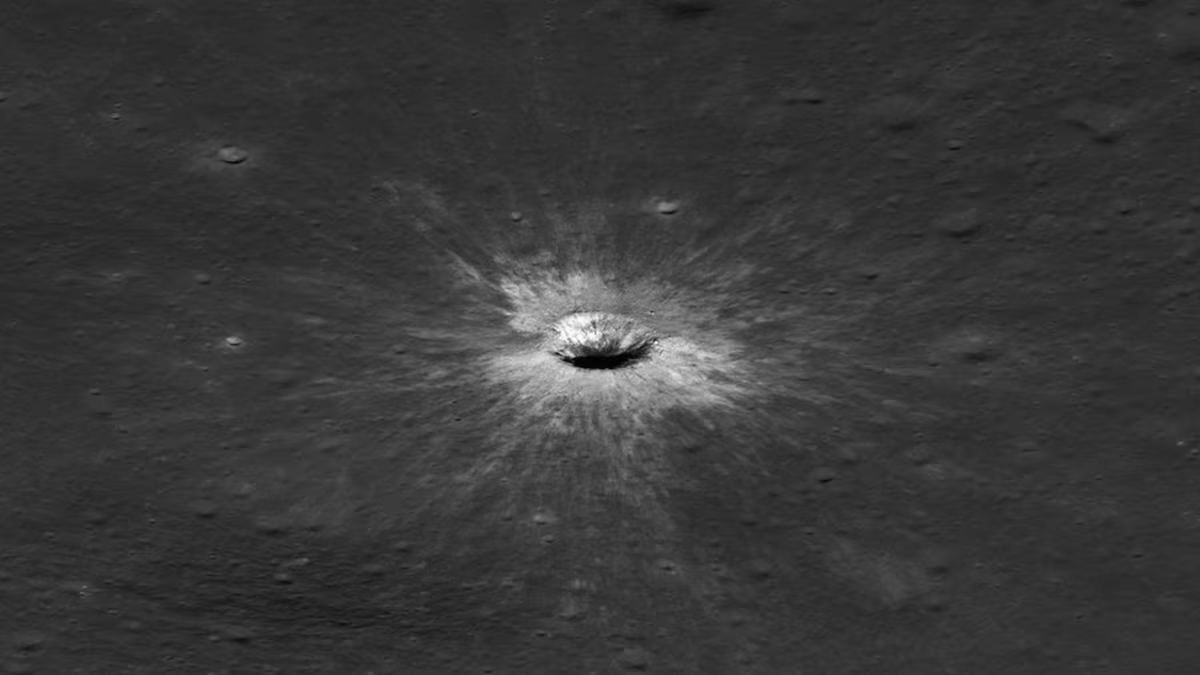



NASA announced on September 16, 2026, the discovery of a crater on the Moon named McGetchin, formed between April 11 and May 22, 2024, following the impact of an asteroid or comet fragment. The crater measures 222 meters in diameter and 43 meters deep, making it the largest known recent impact crater in the Solar System. The formation was initially undetected despite its size, with the Lunar Reconnaissance Orbiter (LRO) capturing the first images in October 2025 as a notably bright spot surrounded by a dark halo. Scientists Robert Wagner and Mark Robinson confirmed the discovery by comparing LRO imagery taken before and after the impact.
The crater was named in honor of Thomas McGetchin, former director of the Lunar and Planetary Institute in Houston. According to NASA researchers, impacts of this magnitude on the Moon occur approximately once every 130 to 132 years, making this event statistically rare. The impacting object was estimated to be the size of a three- to six-story building. The discovery was formally confirmed in early 2026, following detailed imaging conducted in autumn 2025.
Beyond the crater itself, scientists documented a surrounding region approximately 6.4 to 7 kilometers in diameter that is about 9 degrees Celsius cooler at night than surrounding terrain. This thermal anomaly results from the distribution of regolith—loosened surface material that retains less heat than undisturbed soil. The findings demonstrate how impacts alter the lunar surface and may affect rover operations. Two peer-reviewed studies on the discovery were published in Science Advances, with research led by scientists including Mark Robinson from Intuitive Machines and David Paige from UCLA. The discoveries underscore the value of continuous lunar surface monitoring as NASA prepares for crewed missions and base construction on the Moon.
Why This Matters
The McGetchin crater discovery documents a rare large-scale impact event on the Moon in 2024, detected by orbital imagery in 2025 and confirmed in 2026. The finding provides measurable data on lunar surface impact frequency (approximately once per 130–132 years), thermal properties of impact zones, and regolith distribution—information relevant to NASA's planned crewed lunar missions and permanent base construction. The peer-reviewed confirmation in Science Advances establishes a baseline for monitoring ongoing lunar geological activity.
Timeline & Sources
Sep 16, 2026
WireNASA publicly announces McGetchin crater discovery
Sep 16, 2026
WireTwo peer-reviewed studies published in Science Advances
Related Signals
Sources
- NASA anuncia a descoberta na Lua da maior cratera recente do Sistema SolarEstadãoMediaSep 21, 2026
- Lua tem nova cratera, maior que o ColiseuJornal O SulMediaSep 21, 2026
- Cientistas da NASA descobriram que uma sonda espacial registrou uma nova cratera na Lua com dimensões superiores às do Coliseu de RomaBrasil 247MediaSep 19, 2026